Pipe & Tube Weight Calculator — Steel, Aluminum & Stainless
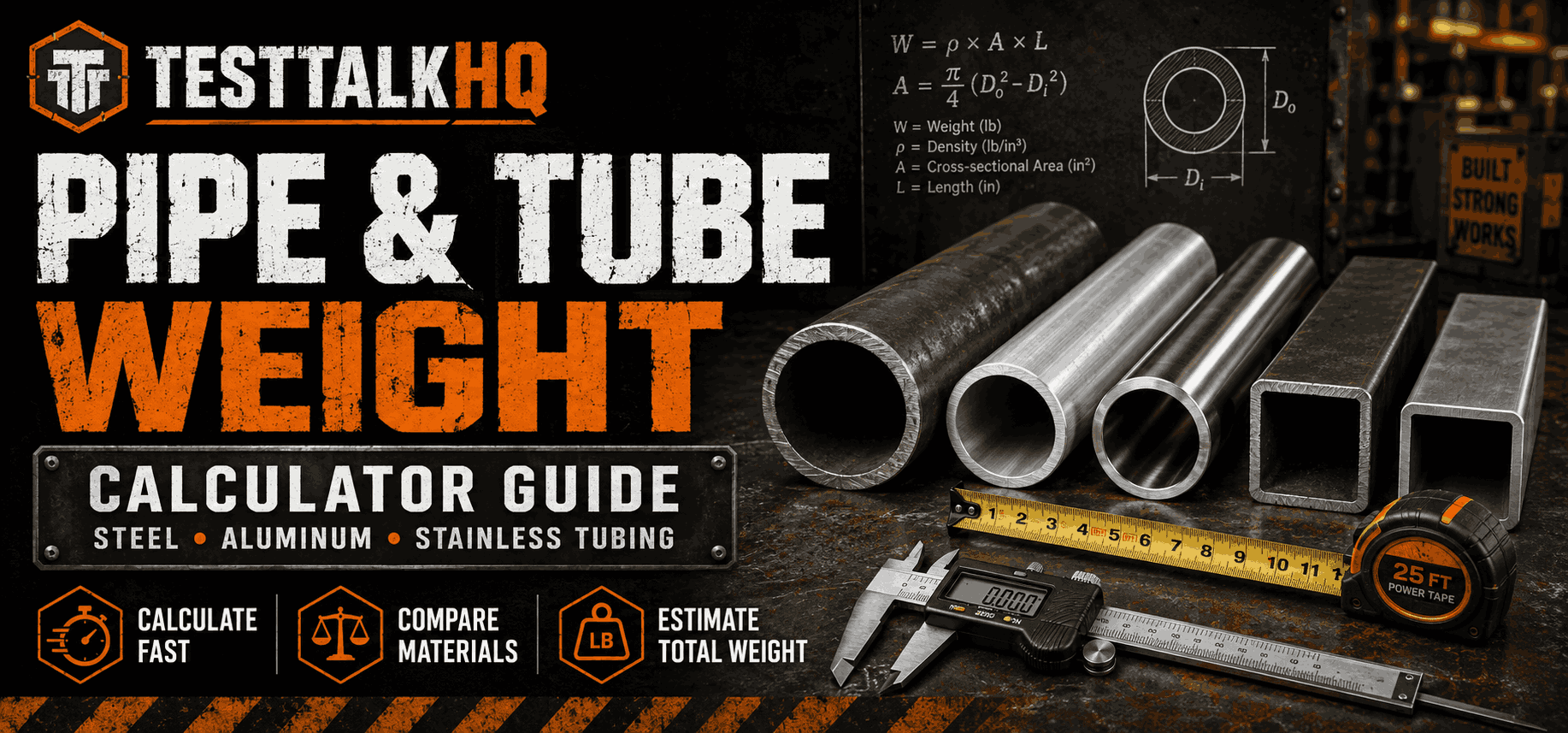
Enter your outside diameter, wall thickness, material, and length — get weight in pounds instantly. No guessing on job bids or crane picks.
Getting the weight wrong on a structural job is not just a math error — it is a safety problem. Undersized lifting equipment, overloaded supports, and miscalculated shipping costs all trace back to someone guessing instead of calculating.
Material Densities Quick Reference
Densities used in the calculator when inputs are in inches. Always verify exotic alloys before bidding large jobs.
| Material | lb/in³ | g/cm³ |
|---|---|---|
| Carbon Steel (A500, A53) | 0.2833 | 7.84 |
| Stainless 304 | 0.2870 | 7.93 |
| Stainless 316 | 0.2890 | 7.99 |
| Aluminum 6061 / 6063 | 0.0975 | 2.70 |
| Aluminum 5052 | 0.0975 | 2.68 |
| Copper | 0.3240 | 8.96 |
| Brass | 0.3060 | 8.47 |
| Titanium Grade 2 | 0.1630 | 4.51 |
Need the numbers, not the lecture?
Run OD, wall, material, and length through the calculator — get total weight and lb/ft without spreadsheet errors.
Why Pipe and Tube Weight Matters
- Job bidding — material cost and freight are priced by weight
- Structural loads — dead load on frames and support structures
- Crane picks — you need actual weight before you lift
- Shipping estimates — freight carriers charge by weight
How the Weight Formula Works
- OD = outside diameter (inches)
- ID = inside diameter (OD minus 2× wall thickness)
- 0.7854 = π/4
- Length = inches
- Density = pounds per cubic inch
This gives weight in pounds when all inputs are in inches. The calculator handles metric conversions automatically.
Pipe vs. Tube: What is the Difference?
Pipe (NPS sizing)
Sized by nominal pipe size — which does not match actual OD. A 2 in pipe is not 2 in OD. Specified by NPS and schedule (Sch 40, Sch 80). Used for plumbing and pressure systems.
Tube (actual OD sizing)
Sized by actual outside diameter. A 2 in tube is 2.000 in OD. Wall thickness given directly in inches. Used for structural frames, roll cages, furniture, and most fabrication work.
Always enter the actual OD — not the nominal pipe size. Using 2.000 in when the actual OD is 2.375 in gives you a weight that is about 40% too low.
Common Pipe Schedules — Carbon Steel Round Pipe
| NPS | Actual OD (in) | Sch 40 Wall | Sch 80 Wall | Sch 40 lb/ft | Sch 80 lb/ft |
|---|---|---|---|---|---|
| 1/2 in | 0.840 | 0.109 | 0.147 | 0.85 | 1.09 |
| 3/4 in | 1.050 | 0.113 | 0.154 | 1.13 | 1.47 |
| 1 in | 1.315 | 0.133 | 0.179 | 1.68 | 2.17 |
| 1-1/4 in | 1.660 | 0.140 | 0.191 | 2.27 | 3.00 |
| 1-1/2 in | 1.900 | 0.145 | 0.200 | 2.72 | 3.63 |
| 2 in | 2.375 | 0.154 | 0.218 | 3.65 | 5.02 |
| 2-1/2 in | 2.875 | 0.203 | 0.276 | 5.79 | 7.66 |
| 3 in | 3.500 | 0.216 | 0.300 | 7.58 | 10.25 |
| 4 in | 4.500 | 0.237 | 0.337 | 10.79 | 14.98 |
| 6 in | 6.625 | 0.280 | 0.432 | 18.97 | 28.57 |
Square HSS — Carbon Steel
| Size | Wall (in) | lb/ft |
|---|---|---|
| 1 in × 1 in | 0.120 | 1.35 |
| 1-1/2 in × 1-1/2 in | 0.120 | 2.09 |
| 2 in × 2 in | 0.120 | 2.91 |
| 2 in × 2 in | 0.188 | 4.32 |
| 3 in × 3 in | 0.188 | 6.87 |
| 3 in × 3 in | 0.250 | 8.81 |
| 4 in × 4 in | 0.250 | 12.21 |
| 4 in × 4 in | 0.375 | 17.27 |
| 6 in × 6 in | 0.250 | 18.96 |
Round Structural Tubing — Carbon Steel
| OD | Wall (in) | lb/ft |
|---|---|---|
| 1 in | 0.120 | 1.13 |
| 1-1/2 in | 0.120 | 1.77 |
| 2 in | 0.120 | 2.41 |
| 2 in | 0.188 | 3.65 |
| 3 in | 0.188 | 5.61 |
| 4 in | 0.188 | 7.57 |
| 4 in | 0.250 | 9.86 |
Aluminum vs. Steel — Weight Savings
Aluminum is roughly one-third the weight of steel for identical dimensions. 6061 aluminum is about 34% the density of A500 carbon steel — significant on any job where weight matters.
| Size | Wall | Steel (lb/ft) | Aluminum (lb/ft) | Savings |
|---|---|---|---|---|
| 2 in round | 0.120 | 2.41 | 0.83 | 66% |
| 2 in × 2 in square | 0.120 | 2.91 | 1.00 | 66% |
| 3 in round | 0.188 | 5.61 | 1.93 | 66% |
| 4 in round | 0.250 | 9.86 | 3.39 | 66% |
Weight savings are consistent because it is purely a density ratio. Use aluminum where you can, then size up wall thickness or diameter if load-bearing requirements demand it.
Stainless Steel Tube
Stainless runs about 1–2% heavier than carbon steel for identical dimensions — close enough that most estimators use carbon steel weights as a proxy. The bigger consideration is cost: stainless is 4–6× the price of A500 carbon by weight.
304 stainless is standard for most fabrication. 316 is used in marine and chemical processing. Weight difference between 304 and 316 is negligible for estimating.
Tips for Accurate Job Bid Estimates
- Account for cut waste: add 3–5% for saw kerfs and short drops when ordering sticks.
- Do not forget fittings and weld wire: run gussets and flanges through the calculator separately.
- Use actual OD, not nominal: look up NPS and schedule before calculating.
- Check density on exotic alloys: Inconel, Hastelloy, duplex — look up actual density.

Need metal weight calculations on the job without a browser? WeldKit includes weight calculators for steel, aluminum, stainless, and more — works offline on your phone. Get WeldKit Free on Google Play
Frequently Asked Questions
How do you calculate pipe weight per foot?
Use (OD² − ID²) × 0.7854 × material density with OD and wall in inches.
What is the difference between pipe and tube weight?
Same formula — the difference is how you size OD and wall (NPS/schedule vs actual OD).
Is aluminum tube lighter than steel?
Yes — about 66% lighter for the same OD and wall because density is roughly one-third.
Can I use carbon steel lb/ft for stainless estimates?
Usually within 1–2% for quick bids; verify on critical lifts.
Conclusion
Stop guessing on bids and lifts. Enter actual OD, wall, material, and length in the Pipe & Tube Weight Calculator and build your estimate from real numbers.