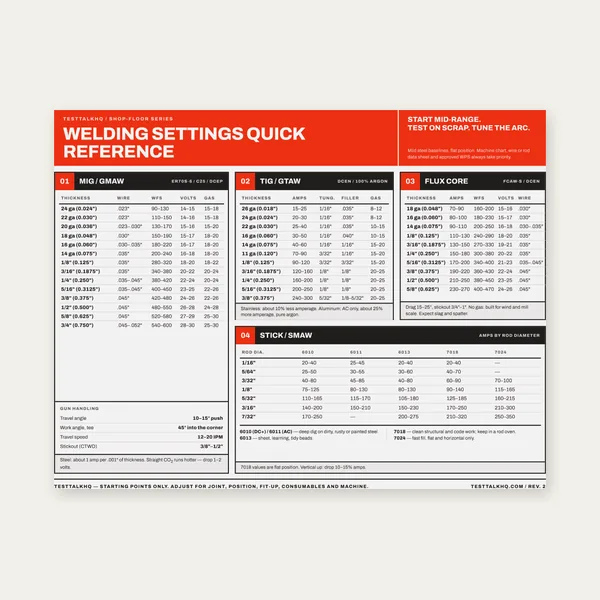
Welding Reference Card
One page. MIG, TIG, stick and flux core settings by thickness.
$3.99
BuyEvery Electrode Explained
Decode AWS stick electrode numbers, pick the right rod for your base metal and position, and stop guessing between 6010, 7018, and everything else on the shelf.
Walk into any weld shop and you'll see the same boxes on the rack. Each rod exists for a reason — wrong choice means porosity, failed inspection, or a bead that looks fine until it cracks two days later. Here is what the common electrodes actually do in the field.
E6010 runs on DC+ (DCEP) only. Forceful arc, deep penetration, fast-freezing slag — built for pipe root passes, structural work on mill scale and light rust, and all-position welding when you cannot babysit the prep. It cuts through less-than-clean steel better than any general-purpose rod. Unforgiving arc: arc length and travel speed matter. If your machine is AC-only, 6010 will not run — use E6011 instead.
E6011 shares the cellulosic penetrating character of 6010 but runs on AC or DC. Farm rigs, maintenance welders, and older buzz boxes without DC output use 6011 for dirty metal, all-position work, and field repairs. On DC+ it behaves similarly to 6010; on AC the arc feels slightly different but the use case overlaps. Not low hydrogen — do not substitute for 7018 on coded structural work.
E6013 is the forgiving rod: easy arc start, smooth bead, light slag, moderate penetration. Runs on AC, DC+, or DC−. Best on clean, thin material in flat and horizontal. Vertical and overhead are possible but not its strength. Good for hobbyists and light fabrication. Will not burn through heavy rust the way 6010 does — clean the joint or step up to a penetrating rod.
E7018 is what structural codes expect. Low-hydrogen coating produces strong, ductile welds with minimal diffusible hydrogen — the kind that pass X-ray on bridges, pressure vessels, and AWS D1.1 work. Runs DC+ or AC, all positions with a drag technique. Must stay dry. Open the box in humid air and moisture in the flux causes porosity, worm tracks, and failed bend tests. Not a rod you leave in the bed of a truck overnight.
E7024 is a drag rod for production. Iron powder in the coating pumps metal into the joint at high deposition rates — great for fillets and laps in flat and horizontal where speed matters. Position code 2 means flat and horizontal only. Do not use vertical or overhead; the slag cannot support the puddle out of position. AC or DC+.
E308L matches 304/308 stainless base metal — standard austenitic filler for same-alloy fabrication and repair. E309L is the dissimilar-metal rod: carbon steel to stainless, unknown stainless grade, or buttering before a carbon-steel fill. Higher chromium and nickel buffer the dilution zone. E316L matches 316 base metal and adds molybdenum for chloride and corrosion resistance — marine, chemical, and food-grade 316 work. All three run DC+ and need dry storage like 7018.
Never stick a 7018 on cast iron and hope for the best. ENi-Cl (99% nickel) produces soft, machinable deposits for crack repair and buildup — short stringer beads, minimal base-metal melting, peen between passes on heavy sections. ENiFe-Cl (nickel-iron) gives higher strength with less machinability — better for structural cast iron repairs where you need more strength and can live with harder deposits. Both run DC+ with low heat input.
An AWS stick electrode number like E7018-1 H4R tells you everything if you know how to decode it. Start with the four digits after the E:
First two digits — tensile strength: 60 = 60,000 PSI minimum weld metal tensile strength. 70 = 70,000 PSI. A 7018 deposit is stronger than a 6013 deposit. Match or exceed base metal requirements per your WPS or code.
Third digit — welding positions: 1 = all positions. 2 = flat and horizontal only. A 7024 with a 2 in the third position is not rated for vertical or overhead work regardless of how confident you feel.
Fourth digit — current type and coating: 0 = cellulosic sodium (6010, DC+ only). 1 = cellulosic potassium (6011, AC/DC). 3 = rutile potassium (6013, easy arc). 8 = low-hydrogen potassium (7018, AC/DC). 4 = iron powder (7024, high deposition).
What "low hydrogen" means and why it matters: The coating is formulated to produce minimal diffusible hydrogen in the weld metal. High hydrogen in a hard, restrained joint causes delayed cracking — sometimes hours or days after welding. That is why 7018 is required on structural and pressure work, and why it must be stored dry. Low hydrogen is not marketing — it is a metallurgical requirement on code jobs.
| Electrode | Tensile Strength | Positions | Current Type | Coating | Best Uses | Skill Level |
|---|---|---|---|---|---|---|
| E6010 | 60,000 PSI | All | DC+ | Cellulosic | Pipe root, dirty steel, deep penetration | Advanced |
| E6011 | 60,000 PSI | All | AC / DC | Cellulosic | Field repair, AC machines, dirty metal | Advanced |
| E6013 | 60,000 PSI | Flat/horiz best | AC / DC | Rutile | Thin metal, light fab, beginners | Beginner |
| E7018 | 70,000 PSI | All | AC / DC+ | Low hydrogen | Structural, code work, X-ray quality | Intermediate |
| E7024 | 70,000 PSI | Flat/horiz only | AC / DC+ | Iron powder | Production fillets, high deposition | Intermediate |
| E308L | 85,000 PSI | All | DC+ | Low hydrogen | 304/308 stainless same-base | Intermediate |
| E309L | 80,000 PSI | All | DC+ | Low hydrogen | Dissimilar, carbon to stainless | Intermediate |
| E316L | 80,000 PSI | All | DC+ | Low hydrogen | 316 stainless, corrosion service | Intermediate |
| ENi-Cl | ~50,000 PSI | All | DC+ | Nickel | Cast iron repair, machinable | Advanced |
| ENiFe-Cl | ~70,000 PSI | All | DC+ | Nickel-iron | Cast iron, higher strength | Advanced |
Stop grabbing whatever box is open. Run through these six questions before you strike an arc:
For a guided recommendation based on your inputs, use the Welding Rod Selection Calculator.
Starting ranges for common electrodes. Adjust for your machine, rod brand, and joint fit-up. When in doubt, start low and walk up.
| Electrode | 3/32" | 1/8" | 5/32" | 3/16" |
|---|---|---|---|---|
| E6010 | 40–75 A | 75–125 A | 110–165 A | 140–215 A |
| E6011 | 40–80 A | 80–130 A | 115–170 A | 145–220 A |
| E6013 | 40–85 A | 90–140 A | 120–175 A | 150–230 A |
| E7018 | 70–100 A | 110–160 A | 150–220 A | 180–275 A |
| E7024 | — | 140–190 A | 180–250 A | 220–300 A |
| E308L / E309L / E316L | 60–90 A | 90–130 A | 120–170 A | 150–200 A |
| ENi-Cl / ENiFe-Cl | 50–80 A | 70–110 A | 90–140 A | 110–160 A |
For exact amperage by diameter and position, use the Stick Welding Calculator.
7018 flux is hygroscopic — it absorbs moisture from the air. Welding with damp 7018 puts hydrogen into the weld metal and produces porosity, worm tracks, and under-bead cracking that shows up after the weld looks fine. On coded work, wet 7018 fails inspection every time.
Rod oven: Store opened 7018 at 250–300°F in a heated holding oven on the job. Same-day use from a sealed box is fine in dry climates; overnight in humid air is not. Reconditioning per manufacturer spec is typically 700–800°F for several hours if rods have been exposed — check the box.
Field tips: Only open what you will burn in a shift. Keep rods in a sealed portable oven or tight container with desiccant. Never mix damp rods back into dry stock. Cellulosic rods (6010, 6011) tolerate moisture better but still store dry when possible. Stainless electrodes also need dry storage — treat 308L like 7018.
Run your job inputs through the Welding Rod Selection Calculator for a primary electrode recommendation with amperage range. Then dial exact settings on the Stick Welding Calculator by diameter and position.
Both are cellulosic penetrating electrodes for all-position work on dirty or rusty steel. E6010 runs DC+ only. E6011 runs AC or DC and is the go-to when your machine has no DC output. Arc characteristics are similar; 6010 is slightly more aggressive on pipe root passes with DC.
Use E7018 for structural work, coded welds, thick material, and any joint that requires low hydrogen and 70,000 PSI deposit strength. Use E6013 for thin material, light fabrication, and beginner practice on clean steel in flat and horizontal. E7018 must be kept dry; E6013 is more forgiving in storage.
Yes. E7018 is designed to run on AC or DC+ (reverse polarity). Many farm and field welders run 7018 on AC successfully. DC+ often gives a slightly more stable arc, but AC is code-acceptable and common on older machines. E6010, by contrast, requires DC+ and will not run on AC-only buzz boxes.
7018 flux absorbs moisture from the air. Hydrogen from damp flux causes porosity, worm tracks, and delayed cracking in hard, restrained joints — failures that show up during X-ray or bend testing. A rod oven at 250–300°F keeps opened 7018 dry on the job site. Exposed rods can sometimes be reconditioned per the manufacturer bake schedule, but prevention beats reconditioning.
One page. MIG, TIG, stick and flux core settings by thickness.
$3.99
Buy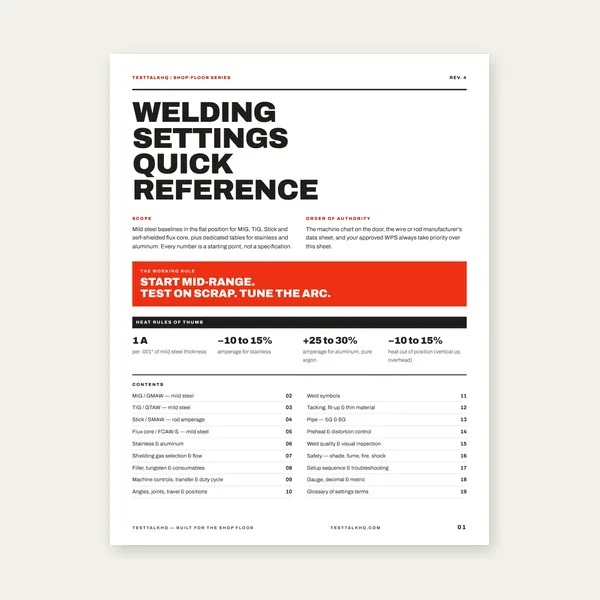
19 pages. Four processes, stainless and aluminum, symbols and inspection.
$12.99
Buy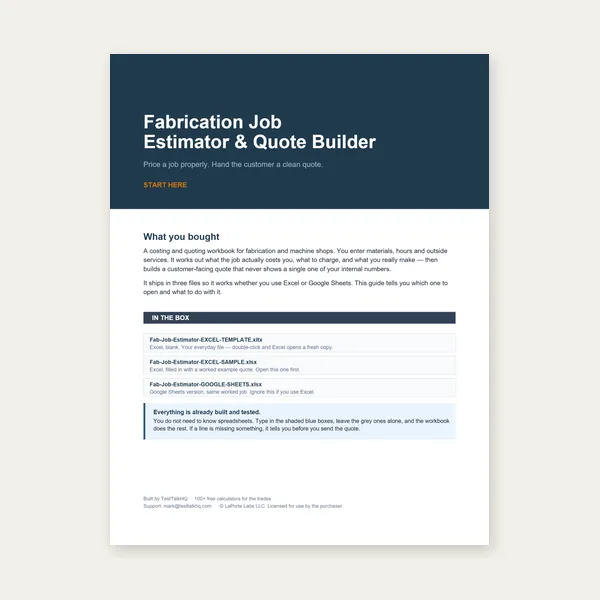
Price the job, then hand over a quote with no internal numbers.
Excel or Google Sheets. Best on a computer.
$29.00
Buy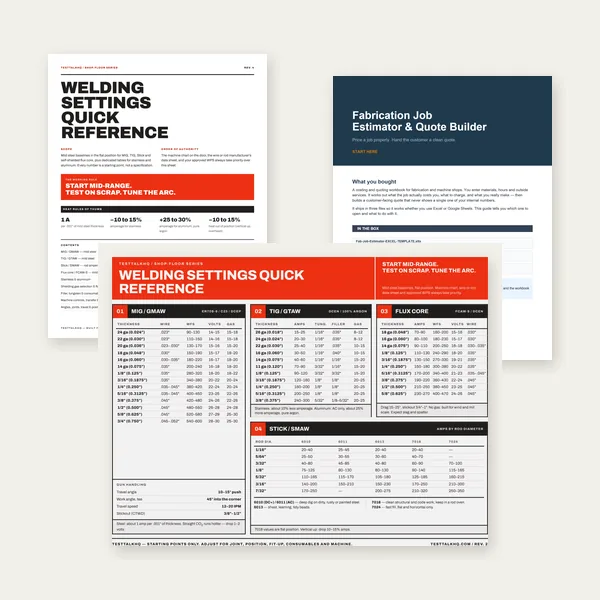
Card, 19-page guide and the estimator workbook. All six files.
Excel or Google Sheets. Best on a computer.
$34.99
$45.98 if bought separately — save $10.99
BuyCheckout opens in a new tab.