
A standing seam clip has to hold the panel down against wind and let it change length without fatiguing its own fastening. Fixed and floating clips are two different answers to that tension. Which one a job needs is not a preference: it falls out of the run length, the temperature range the panel sees, and how much the structure underneath is willing to move.
The two things a clip has to do
A standing seam clip is asked to do two jobs at once, and they pull against each other. MCA states both plainly: the clip has to resist wind uplift and other design loads, and it has to let the panel change length without fatiguing its own fastening. A clip that grips well enough to never let go fails the second job; a clip that slides freely enough to never bind has to be engineered not to fail the first.
Fixed and floating clips are two different answers to that tension, and the choice is not a matter of preference. It follows from the run length, the temperature range and how stiff the thing underneath is.
What each one actually is
Fixed clip — one piece
A single part. Its base is fastened to the structure and its upper element is seamed or snapped into the panel rib. There is no sliding joint inside it. MBCI puts the consequence directly: a fixed clip is limited by and dependent on the substrate’s ability to expand and contract with the roof system.
That does not mean the roof cannot move. It means the movement has to be accommodated somewhere other than inside the clip — flexure of the clip leg, flexibility of the cladding, and roll of the purlin the clip is fastened to. MCA describes this as minimal differential movement through limited flexure of the clip and the structure it is affixed to, and notes it may be prudent for short panel lengths or flexible structures, where the accumulated movement is small.
Floating clip — two piece
A base that is fastened to the structure and stays put, and a hook or tab that engages the panel and slides relative to the base. The movement happens inside the clip. MBCI: these clips allow greater thermal movement of the panel, independent of the substrate, while still holding the panel down.
The trade is that a two-piece clip has a finite travel, and MCA notes the obvious corollary — a two-piece clip has a limitation as to the maximum dimension of panel movement it can take.
Where the line falls
There is no universal run length at which fixed clips stop being acceptable, because the answer depends on three things at once.
| Factor | Pushes toward fixed clips | Pushes toward floating clips |
|---|---|---|
| Panel run | Short. The accumulated movement is small enough for flexure to absorb. | Long. Movement accumulates linearly with run length and quickly exceeds what flexure can take. |
| Temperature range | Mild climate, light or reflective panel colour, conditioned and insulated building. | Big seasonal swing, dark panel, unconditioned or uninsulated building. |
| Substrate | Flexible — open framing, Z or C purlins that can roll a little. | Stiff — a structural deck, concrete, or heavy framing with nowhere to give. |
| Panel material | Steel, which moves least of the common roofing metals. | Aluminum, which moves roughly twice as far as steel for the same run and temperature change. |
| Wind zone | No difference in kind — both need a clip analysis for field, edge and corner zones. | No difference in kind. |
Notice what is not in that table: aesthetics, price, and what the crew used last time. Those decide which floating clip, not whether you need one.
The comparison, side by side
| Fixed (one-piece) clip | Floating (two-piece) clip | |
|---|---|---|
| Where movement happens | Clip leg flexure, cladding flexibility, purlin roll | Inside the clip, between base and hook |
| Depends on the substrate | Yes — a stiff deck removes the mechanism | No — independent of the substrate |
| Practical run length | Short runs only | Long runs, up to the clip’s published travel |
| Travel limit | Not a stated dimension; a stiffness question | A published number you can check against |
| Installation temperature matters | Less, because there is no slot to bottom out | Critically — a centred clip is the whole point |
| Parts and cost | Fewer parts, lower unit cost | More parts, higher unit cost |
| Failure mode when wrong | Fastener fatigue, purlin roll, panel distortion | Bottomed-out clip, then behaves as an unplanned fixed point |
| Can you check it in the field | Hard — flexure is distributed | Yes — scribe a mark and look again at a different temperature |
Any trade
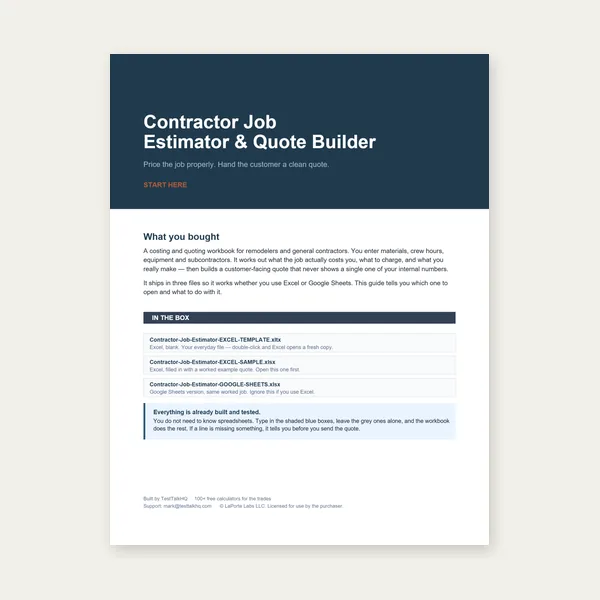
Contractor Job Estimator
$29.00
BuyCheckout opens here — you stay on this page.
What the details are built with
None of this works unless the roof is put together so the panel can move. That means a fixed point that is genuinely fixed, laps sealed with something that stays flexible, trim that is cut to allow travel, and a layout that was snapped before the first panel rather than argued about after the tenth.

Malco S2R 3" Hand Seamer
- Hand seaming at the eave cleat, closures and trim returns
- A fixed end only holds if it is locked, not merely screwed
- Also the tool for dressing a panel end that has been worked
Cofair Quick Roof Butyl Seam Tape
- Butyl stays flexible instead of going brittle at a moving lap
- End laps and expansion details are where the movement concentrates
- Non-curing, so it keeps sealing through tens of thousands of cycles

TAJIMA Chalk‑Rite CR301JF Jam Free Chalk Line
- Snap the fixed-point line before the first panel goes down
- A scribe mark at a clip is how you prove the roof is moving
- Bold 1 mm line stays readable on bright metal
Metal Roofing Screws, Self Tapping Hex Washer Head
- Exposed-fastener panels have no clip, so the movement lands here
- The bonded washer has to keep sealing as the hole works
- This is why screw-down systems carry maximum run lengths

Malco M2006 Offset Aviation Snips
- Offset handles keep your knuckles clear on long trim cuts
- Expansion details mean more cut trim, not less
- Pairs with a right-cut for working both directions of a run
As an Amazon Associate, TestTalkHQ earns from qualifying purchases. Prices and availability can change.
Three things that complicate the choice
A fixed clip is not the fixed point
This trips people up on terminology alone. A roof built entirely on floating clips still needs one pinned location — a cinch plate and a row of fasteners at the eave or the ridge, or a deliberate fixed connection mid-run. Some systems create that pin by using one-piece fixed clips in a row at the anchorage. Others use a separate anchor detail. Either way, “fixed clip” describes the part; “fixed point” describes the location where the roof is anchored, and the two are not the same decision.
Low fixed, high fixed, low floating, high floating
Most profiles publish a family rather than a pair, with different clip heights to accommodate insulation thickness and different base configurations for decks versus open framing. The height variants are about the assembly build-up, not about movement. Read the family as two questions: how tall does the clip need to be, and does it need to slide.
You cannot mix clips between profiles
MCA is explicit that clips are specific to the dimensional characteristics and seam design of a particular panel profile, and often to the manufacturer, and that interchanging clips between panels should only be done after engineering evaluation by a registered design professional or by testing. A clip that fits physically is not the same as a clip that has been tested with that seam for uplift and for non-binding travel.
Situation by situation
| The job | What to reach for | Why |
|---|---|---|
| Short steel runs on open purlins, mild climate | Fixed clips are defensible | Small accumulated movement, and a flexible substrate that can take it. Run the arithmetic to confirm the total is genuinely small. |
| Anything over roughly 30–40 ft of run | Floating | Movement is linear in run length. Past a point no amount of flexure absorbs it, and the fastening starts fatiguing instead. |
| Aluminum panels | Floating, and check travel carefully | Aluminum moves about twice as far as steel. A run length that is fine in steel may not be in aluminum. |
| Structural deck, concrete, or a stiff frame | Floating | A fixed clip relies on the substrate giving a little. A stiff deck removes the only mechanism it had. |
| Unconditioned or uninsulated building | Floating | Nothing moderates the underside temperature, so the panel sees close to the full swing. |
| Dark panel colour in strong sun | Floating | Colour does not change the coefficient, but it raises the peak panel temperature, which raises the movement. |
| Run longer than the floating clip’s travel | Move the pin to mid-run, or add an expansion joint | Halving the arm halves the demand at each end. Failing that, a roof step takes the movement in flashing and restarts the run. |
| Retrofit over an existing screw-down roof | Floating, on a new sub-purlin system | The old roof’s slotted screw holes are the evidence of what happens without one. |
The honest summary
Floating clips are the default for a reason, and the reason is arithmetic rather than fashion. Panel movement grows linearly with run length and does not care what anybody would prefer; a fixed clip’s capacity to absorb it depends on the substrate being willing to move, which on a modern structural deck it largely is not. As soon as the run is long enough that the movement is measured in fractions of an inch rather than thousandths, the movement needs a designed place to go.
Fixed clips remain legitimate, and MCA says so, on short runs and flexible structures. The mistake is not choosing them — it is choosing them without running the number first, or carrying a detail from a 20 ft canopy onto a 90 ft warehouse because it worked last time.
And whichever type goes on, the same two conditions apply: there has to be one deliberate fixed point, and everything the panel touches has to allow the movement. MBCI’s closing line on the subject is the one worth keeping: if the roof you are buying is meant to expand and contract, everything that ties into it has to be able to expand and contract as well.