This calculator saves lives. Every year, fabricators and DIYers are seriously injured or killed by exploding grinding discs. Most of these accidents are 100% preventable by doing one simple calculation before mounting your disc.
In this guide, you’ll learn how to verify your disc speed is safe, understand the difference between RPM and SFPM, and avoid the most common mistakes that cause disc explosions. Use the Angle Grinder Disc Speed Calculator to verify your setup before every job.
Table of Contents
Why Grinding Discs Explode
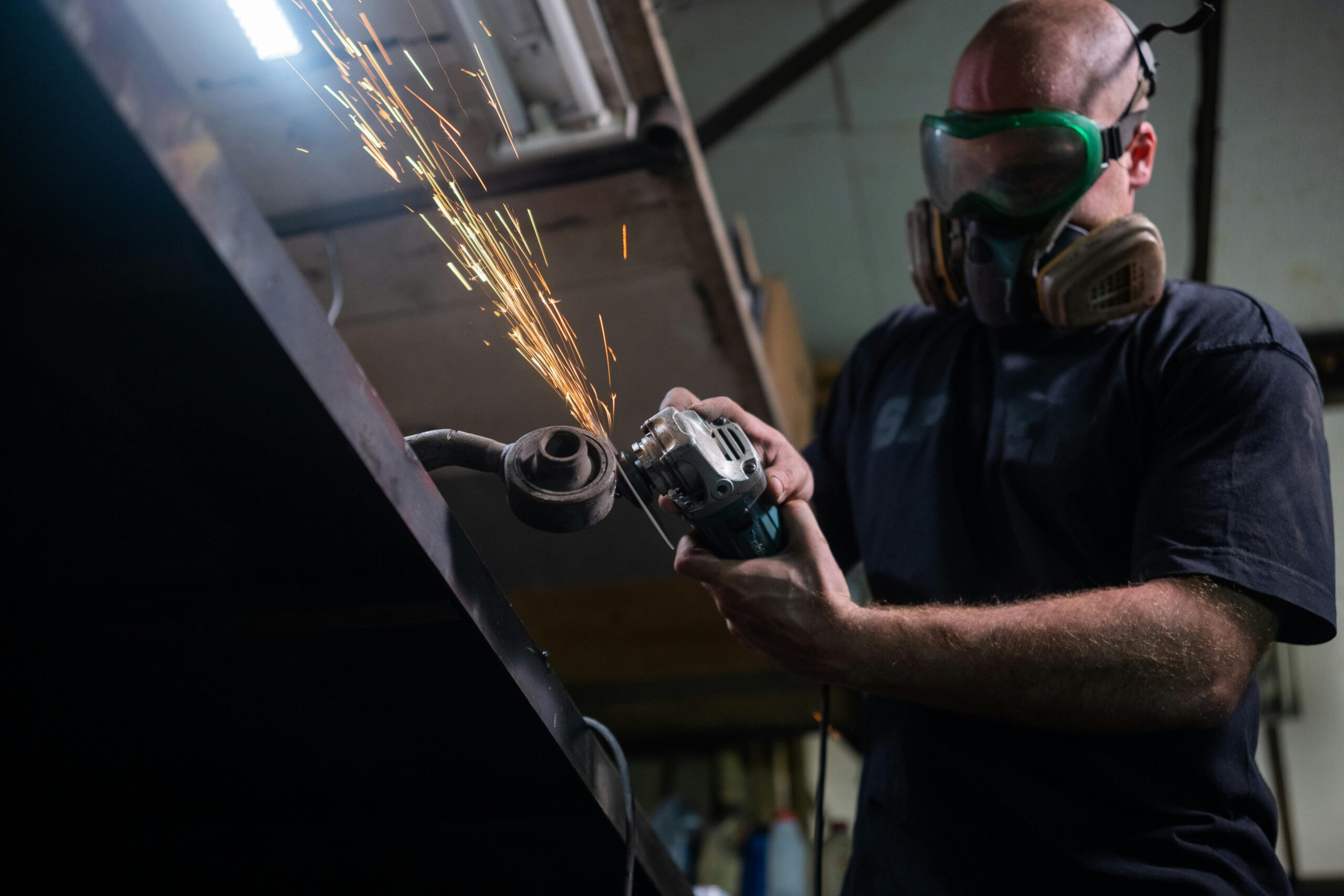
Grinding discs explode when they spin faster than their maximum rated speed. The centrifugal force literally tears the disc apart, sending razor-sharp fragments flying at hundreds of miles per hour. These fragments can penetrate skin, muscle, and bone.
The most common cause: Using a disc rated for 11,000 RPM on a grinder that spins at 13,000 RPM. The disc looks fine when you mount it. It spins fine for a few seconds. Then it shatters.
Here’s what happens at the molecular level: As the disc spins faster than its rated speed, centrifugal stress exceeds the bonding strength of the abrasive material. The disc doesn’t “wear out” – it catastrophically fails all at once.
The Real Numbers
A 4.5″ grinding disc spinning at 13,000 RPM has an edge speed of over 240 feet per second – that’s 164 miles per hour. When that disc explodes, those fragments are traveling faster than a major league fastball.
The force increases exponentially with speed. A disc spinning 20% over its rated RPM experiences 44% more centrifugal stress. A disc spinning 50% over its rating? More than double the stress.
Use the Angle Grinder Disc Speed Calculator to see exactly how much stress your disc is under.
Understanding RPM vs SFPM
This is where most people get confused. There are two ways to measure grinding disc speed:
RPM (Revolutions Per Minute): How many times the disc spins around in one minute. Your angle grinder is rated in RPM – for example, 11,000 RPM or 6,600 RPM.
SFPM (Surface Feet Per Minute): How fast the edge of the disc is actually moving through space. Discs are often rated in SFPM – for example, 12,200 SFPM maximum.
Here’s the critical part: The same RPM creates different SFPM depending on disc size.
A 4.5″ disc at 11,000 RPM = 12,900 SFPM
A 7″ disc at 11,000 RPM = 20,100 SFPM
A 9″ disc at 11,000 RPM = 25,900 SFPM
This is why you can’t just look at RPM alone. A 9″ disc rated for 6,600 RPM will explode if you put it on an 11,000 RPM grinder, even though “it fits.”
The Conversion Formula
SFPM = (Disc Diameter in inches × π × RPM) ÷ 12
Or simplified: SFPM = Disc Diameter × RPM × 0.262
You don’t need to do this math manually – the Angle Grinder Disc Speed Calculator does it instantly and shows you if your setup is safe with a red/yellow/green indicator.
How to Check If Your Disc Speed Is Safe
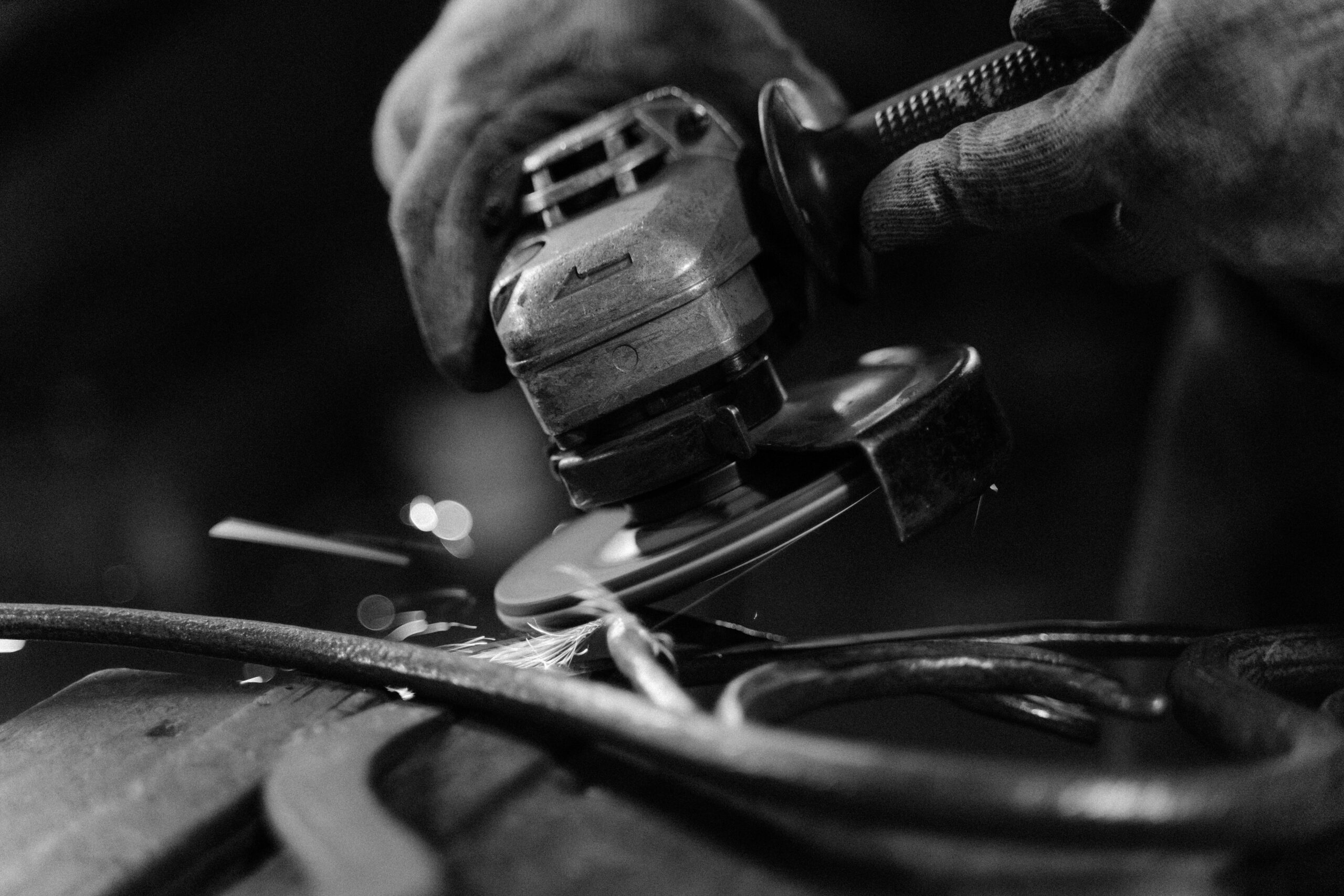
Before you mount any disc on any grinder, follow this three-step verification process:
Step 1: Find Your Grinder’s RPM Rating
Look on the label or name plate of your angle grinder. It will say something like:
- “No load speed: 11,000 RPM”
- “Max RPM: 6,600”
- “Speed: 13,300 min⁻¹” (min⁻¹ means RPM)
If you have a variable speed grinder, check what speed it’s currently set to. Most variable speed grinders range from 3,000-4,000 RPM on the low end up to 11,000-12,000 RPM at maximum.
Step 2: Find Your Disc’s Maximum RPM Rating
Look at the paper label (called the “blotter”) on the center of your disc. It will show:
- “Max RPM: 13,300” or similar
- Sometimes listed as “Max operating speed”
- May also show SFPM rating
Critical: If the label is missing, destroyed, or unreadable, DO NOT USE THAT DISC. Without the rating, you have no way to verify safety. Throw it away.
Step 3: Verify Safety
The disc’s maximum RPM rating must be higher than your grinder’s RPM. Not equal – higher.
Safe examples:
- Grinder: 11,000 RPM | Disc: 13,300 RPM ✓
- Grinder: 6,600 RPM | Disc: 8,500 RPM ✓
- Grinder at setting 3 (7,000 RPM) | Disc: 11,000 RPM ✓
Unsafe examples:
- Grinder: 13,300 RPM | Disc: 11,000 RPM ✗ DANGER
- Grinder: 11,000 RPM | Disc: 11,000 RPM ✗ DANGER (no safety margin)
- Grinder: 8,500 RPM | Disc: 6,600 RPM ✗ DANGER
Use the Angle Grinder Disc Speed Calculator to verify any combination instantly. It will show red for dangerous, yellow for borderline, and green for safe.
Real Injury Examples: Why This Matters
These aren’t hypothetical scenarios. These are documented accidents from OSHA reports and safety coalitions.
Case #1: The Missing Guard
What happened: Bill used a pneumatic sander rated for 18,000 RPM with an 11,000 RPM abrasive wheel to cut a welded bolt. The guard was missing. The wheel fractured immediately, and a large fragment lodged in his left forearm.
Injuries: Hospitalized for three days, emergency surgery required, permanent nerve damage.
What went wrong:
- Tool speed (18,000 RPM) exceeded disc rating (11,000 RPM) by 64%
- No guard to deflect fragments
- Holding workpiece by hand instead of clamping it
- No two-handed operation
How it could have been prevented: Using the disc speed calculator would have shown an immediate red warning. The disc should never have been mounted.
Case #2: The Wrong Disc Size
What happened: A fabricator mounted a 9″ cutoff wheel rated for 6,600 RPM on a large angle grinder set to 8,500 RPM. “It fit on the arbor, so I thought it was fine.” The disc exploded within seconds, sending a fragment through his safety glasses and into his eye socket.
Injuries: Permanent vision loss in one eye, multiple surgeries, disability claim.
What went wrong: Larger discs have higher surface speeds at the same RPM. This 9″ disc at 8,500 RPM was spinning at 19,900 SFPM – well over its 17,280 SFPM maximum rating.
How it could have been prevented: Checking the conversion from RPM to SFPM would have revealed the danger immediately.
Case #3: The Variable Speed Mistake
What happened: An auto body technician used a non-woven finishing disc rated for 7,200 RPM on a variable speed grinder. He forgot to check the speed setting – the grinder was set to maximum (12,000 RPM). The disc melted and disintegrated, causing severe burns on his forearm from hot nylon particles.
Injuries: Second and third-degree burns, skin grafts required.
What went wrong: Non-woven abrasives and soft polishing discs often have lower RPM ratings than cutting or grinding discs. Always verify the disc rating even if you’ve used the grinder before.
How it could have been prevented: Checking the disc label before use and adjusting the variable speed dial to 6,000-7,000 RPM would have prevented the incident entirely.
Common Angle Grinder Speeds by Size
Here are the typical no-load speeds for common angle grinder sizes. Your specific grinder may vary – always check the label.
| Grinder Size | Typical RPM | Typical SFPM (at rated RPM) | Common Uses |
|---|---|---|---|
| 4″ / 4.5″ | 10,000 – 12,000 | 10,500 – 14,100 | General purpose, most common |
| 5″ | 10,000 – 11,000 | 13,100 – 14,400 | Heavier duty fabrication |
| 6″ | 9,000 – 10,000 | 14,100 – 15,700 | Heavy metal removal |
| 7″ | 6,000 – 8,500 | 11,000 – 15,500 | Production cutting, large materials |
| 9″ | 6,000 – 6,600 | 14,100 – 15,500 | Industrial applications, thick steel |
Key insight: Notice that larger grinders spin slower in RPM but achieve similar SFPM ranges. This is by design – the larger diameter compensates for the slower rotation speed.
Always match your disc size to your grinder size. A 9″ disc on a 4.5″ grinder won’t fit properly and creates multiple safety hazards even if the RPM rating is correct.
When to Use Variable Speed Settings
If you have a variable speed angle grinder, you have an extra layer of safety control. Here’s when to reduce speed and when to use maximum RPM.
Always Use Maximum Speed For:
Cutting discs – You want maximum material removal and minimal heat buildup. Running too slow creates heat, burns the metal, and glazes the disc.
Grinding discs (depressed center) – Fast speed keeps the abrasive breaking down properly and removes material efficiently.
Flap discs – Designed to work at high speeds for aggressive stock removal and blending.
Wire wheels – Need centrifugal force to make the wires work properly.
Reduce Speed For:
Non-woven abrasives – These are made from nylon fibers that can melt at high speeds. Run at 50-60% speed (6,000-7,000 RPM on most grinders) to prevent melting and smearing.
Polishing pads – Often rated for lower RPM than cutting discs. Always check the label – many are rated for 7,000-8,000 RPM maximum.
Soft backing pads – Foam and rubber backing pads have lower RPM ratings and will fly apart at high speeds.
Specialty abrasives – Surface conditioning discs, scotch-brite wheels, and other specialty products often have specific RPM requirements listed on the package.
How to Use Variable Speed Safely
1. Check the disc rating first – Don’t assume you can use any speed
2. Start at a lower setting – Dial #3 or #4 on most grinders
3. Check the label on the grinder body – It will show what RPM each dial setting produces
4. Verify with the calculator – Input your dial setting and disc rating into the Angle Grinder Disc Speed Calculator
5. Listen and watch – If the disc is smoking, melting, or loading up, you’re running too fast or too slow
Complete Angle Grinder Safety Checklist
Use this checklist before every job. It takes 30 seconds and could save your life.
Before Mounting the Disc:
□ Check disc for cracks, chips, or damage
□ Perform ring test (tap disc gently – should ring like a bell, not thud)
□ Verify disc label is intact and readable
□ Confirm disc RPM rating is higher than grinder RPM
□ Use disc speed calculator to verify SFPM if needed
□ Check disc size matches grinder size (arbor hole and diameter)
□ Inspect arbor nut and threads for damage
□ Verify correct disc type for the job (cutting, grinding, or finishing)
Before Starting the Grinder:
□ Guard is installed and adjusted properly (180° coverage minimum)
□ Guard positioned to deflect sparks away from face and body
□ Side handle is installed and tight
□ Power cord is in good condition (no frays or damage)
□ Work area is clear of flammable materials
□ Hot work permit obtained if required
□ Workpiece is clamped or secured (never hold by hand)
□ Proper footing and stable work position
Personal Protective Equipment:
□ Safety glasses with side shields (minimum)
□ Face shield for cutting or heavy grinding
□ Hearing protection (grinders are 90-110 dB)
□ Leather gloves (not cloth – sparks stick to fabric)
□ Natural fiber clothing (cotton, leather – not synthetic)
□ Leather apron or jacket for heavy work
□ Respiratory protection if grinding galvanized, painted, or coated materials
□ Steel-toed boots
□ No loose clothing, jewelry, or hanging strings
During Operation:
□ Let grinder reach full speed before contacting work
□ Use two hands at all times
□ Maintain firm grip and stable stance
□ Keep hands away from rotating disc
□ Don’t grind on side of cutting disc
□ Don’t use excessive force
□ Watch for binding or kickback
□ Take breaks to avoid fatigue and vibration injuries
□ Let grinder come to complete stop before setting it down
After Use:
□ Allow grinder to stop completely
□ Unplug or remove battery before changing discs
□ Inspect disc for wear or damage
□ Clean vents and housing
□ Store in dry location
□ Report any damage or defects immediately
Frequently Asked Questions
Can I use a disc that’s the same RPM as my grinder?
No – this is dangerous. The disc’s maximum RPM must be higher than the grinder’s RPM to provide a safety margin. Grinders can exceed their rated no-load speed under certain conditions, and discs weaken with age and use. Always have at least a 10-15% safety buffer.
For example, on an 11,000 RPM grinder, use discs rated for at least 12,000-13,000 RPM.
What’s the difference between RPM and SFPM?
RPM (Revolutions Per Minute) measures how many times the disc spins around. SFPM (Surface Feet Per Minute) measures how fast the edge of the disc is moving. The same RPM creates different SFPM depending on disc size – larger discs have higher SFPM at the same RPM.
The Angle Grinder Disc Speed Calculator automatically converts between RPM and SFPM so you don’t have to do the math.
Can I use a 9″ disc on a 4.5″ grinder if I have an adapter?
Absolutely not. Even if the RPM rating is safe, this creates multiple hazards: excessive torque that can stall or break the motor, guards that don’t cover the disc properly, inability to control the tool safely, and arbor stress that can cause the disc to fly off. Always match disc size to grinder size.
What happens if I use a disc that’s too slow for my grinder?
The disc will explode. The centrifugal force increases exponentially with speed. A disc rated for 8,500 RPM spinning at 11,000 RPM experiences 67% more centrifugal stress than it was designed for. The bonding agent fails and the disc disintegrates.
How do I know what speed setting to use on a variable speed grinder?
Start by checking the disc label for its maximum RPM rating. Then check your grinder’s label or manual to see what RPM each speed setting produces. Set the grinder to a speed that’s below the disc’s rating. Use the calculator to verify.
As a general rule: cutting and grinding discs use max speed, non-woven and polishing use 50-60% speed.
Can I grind with a cutting disc?
No. Cutting discs are thin and designed for cutting straight into material. Grinding on the side of a cutting disc creates lateral stress that can snap the disc instantly. Use proper grinding discs (depressed center or Type 27 discs) for grinding operations.
What’s a “ring test” and why should I do it?
Before mounting a disc, suspend it on a finger through the center hole and tap it gently with a non-metallic object. A good disc will ring like a bell with a clear tone. A cracked or damaged disc will produce a dull thud or dead sound. Never use a disc that fails the ring test – it’s already compromised and will likely fail catastrophically.
Why can’t I remove the guard? It gets in the way.
The guard is not optional – it’s required safety equipment. It deflects sparks, contains disc fragments if the disc breaks, and provides a physical barrier between you and the spinning disc. Operating without a guard is illegal under OSHA regulations and voids all manufacturer warranties. If the guard “gets in the way,” adjust it to a different position or use a different tool for the job.
Can I use liquid coolant on my angle grinder?
No. Unlike bench grinders, angle grinders are not designed for liquid coolants. Water or cutting fluid can cause the disc to explode from thermal shock, damage the motor, or create an electrical hazard. If you need cooling, use air or let the work cool between cuts.
How often should I replace grinding discs?
Replace discs when:
- They reach the minimum diameter marked on the disc
- The label is worn off or unreadable
- They show any cracks, chips, or damage
- They fail the ring test
- They’ve been dropped or impacted
- They vibrate excessively during use
- They’ve been stored for more than 2-3 years (bonding agents degrade)
Is it safe to use a pneumatic die grinder disc on an electric angle grinder?
Only if the RPM ratings match. Pneumatic die grinders often spin at 20,000-25,000 RPM, so their discs are rated accordingly. Using a 25,000 RPM disc on an 11,000 RPM electric grinder is safe. Using an 11,000 RPM disc on a 25,000 RPM die grinder will cause an explosion. Always verify the specific RPM ratings using the calculator.
What do the color codes on abrasive discs mean?
The color of the disc label doesn’t indicate speed rating – it’s typically just branding. However, the color ring on the hub can indicate grade: blue often means a harder bond, brown means standard, and green might indicate a specific abrasive type. Always read the actual printed specs rather than relying on color codes.
Final Thoughts: Don’t Skip the Math
Every angle grinder injury I’ve investigated had one thing in common: the operator skipped a step they knew they should take. They didn’t check the disc rating. They didn’t verify the speed. They removed the guard “just this once.” They held the workpiece by hand “just for a quick cut.”
The math takes 10 seconds. The Angle Grinder Disc Speed Calculator does it instantly. Using a disc that’s even slightly over speed is gambling with permanent injury.
Your hands, eyes, and face are worth more than the 10 seconds it takes to verify your setup is safe. Check every time. No exceptions.
Related Guides:
- Bolt Torque Calculator – Calculate proper torque specs for SAE and metric fasteners
- Wire Gauge Calculator for Welders – Size electrical circuits correctly and prevent fires
- Shop Safety Tools Hub – All safety calculators and guides
- Free Calculators & Tools – Complete tool library
Disclaimer: Angle grinder safety depends on proper disc selection, correct tool operation, appropriate PPE, and following manufacturer guidelines. This calculator and guide provide general information and calculations but cannot account for all variables in your specific situation. Always follow OSHA regulations, manufacturer instructions, and your workplace safety protocols. See our full disclaimer.
Related: Troubleshooting & Disc Choice
Performance issues after speed is verified: Angle Grinder Troubleshooting (uneven wear, vibration, glazing, bogging).
Energy isolation before the guard comes off: Lockout/Tagout Guide. Rigging a load in the same shop: Sling Angle Load Guide.
Choosing the abrasive: Disc Types — Which One for the Job (cutting vs grinding vs flap vs wire).
Any trade
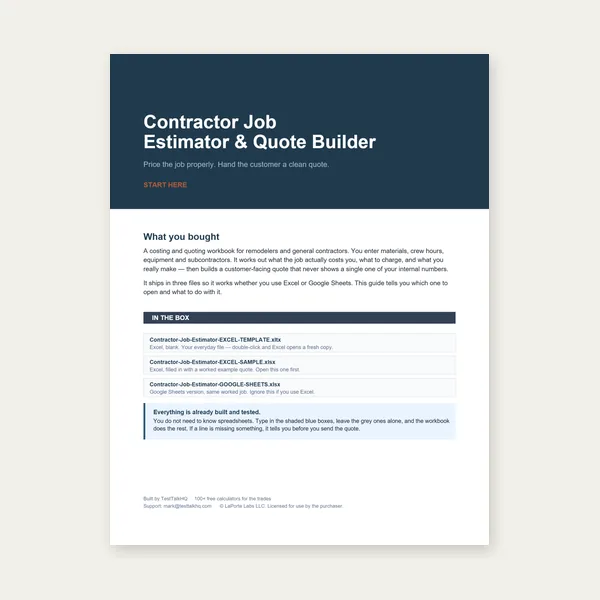
Contractor Job Estimator
Price remodels and GC work, then send a quote with no internal numbers.
Excel or Google Sheets. Best on a computer.
$29.00
BuyCheckout opens in a new tab.