A compressor that is costing too much is almost always diagnosed backwards: somebody looks at the electricity bill, decides the machine is tired, and gets a quote for a new one. Sometimes that is right. Far more often the machine is fine and the plant is running 40 psi higher than anything on it needs, or leaking a third of what it makes, or feeding the intake its own hot exhaust. The difference is three measurements and twenty minutes, and this is the order to take them in.

First, decide whether you actually have a problem
“The compressor is using too much power” is almost never measured before it is asserted. Before chasing anything, get three numbers that can be defended: the capacity in acfm at the inlet, the discharge pressure the machine is loaded to, and the total package input power in kilowatts with the machine fully loaded. Then work out the isentropic efficiency and put it against the published band.
Two-stage lubricated rotary screw (n = 12) 83.6% – 88.6%, median 86.2%
If you land near or above the median for your stage count, the compressor is not your problem and the money is somewhere else in the system — leaks, pressure set too high, or air being used for something that should not be using air. If you land in the bottom quartile, keep reading.
The order to chase it in
These are ordered by how often they turn out to be the cause and how cheap they are to rule out, not by how interesting they are.
1. The system pressure is higher than anything on it needs
By a distance the most common finding, and the cheapest to fix. Power tracks the pressure ratio, so running 175 psig for a plant whose worst tool wants 90 psi at its inlet is burning 16.1% against a 125 psig setting, before you count the extra leakage and the extra unregulated consumption that higher pressure causes everywhere else.
Walk the plant and find the genuine highest-pressure requirement at the tool inlet, not at the header. Then check whether that requirement is real or whether the tool is simply starving on undersized pipe and a quick coupler — in which case fixing the pipe lets the whole plant pressure come down. Where one genuine outlier exists, regulate that one device up locally and bring the header down around it.
2. Restriction on the inlet
A blocked inlet filter lowers P1, which raises the pressure ratio the machine has to work across while simultaneously reducing the mass of air in every cubic foot it swallows. You lose capacity and gain specific power at the same time, which is the worst possible combination and reads exactly like a worn machine.
It is also the cheapest thing in the room to eliminate. Check the filter restriction indicator if there is one, and if there is not, fit a new element and see whether the numbers move. In a shop that does any grinding, sanding or blasting, inlet filters block far faster than the service interval assumes.
3. The machine is unloading rather than working
Everything on the calculator page is a full-load figure. A machine that is efficient loaded and spends most of its life unloaded is still expensive, because an unloaded screw draws a serious fraction of its full-load power to produce no air at all. Across the same 126 published sheets, item 10 — total package input power at zero flow — ran from 22.5% to 40.6% of the full-load figure, median 28.5%.
Item 10 on a fixed-speed CAGI sheet is total package input power at zero flow, and it is the number nobody reads. If your machine spends half the shift unloaded, that figure matters as much as item 11. The fixes are storage, control strategy, or a machine sized closer to the real demand — not a more efficient airend.
4. Leaks, which are demand rather than efficiency
Leaks do not show up as poor isentropic efficiency. They show up as a machine that is loaded far more of the time than the work justifies, and they are usually the largest single line in a plant’s compressed air bill. If the efficiency is fine but the machine never stops, this is where to look. The compressed air leak calculator puts a flow and a cost against each hole.
5. High inlet air temperature
Hot inlet air is thinner air. Feeding a compressor 110°F air recirculated from its own cooler rather than 70°F outside air costs capacity at the same power, so specific power rises even though nothing is wrong with the machine itself. This is a compressor room problem rather than a compressor problem, and it is usually about where the intake is and whether the hot air has anywhere to go.
6. Supply voltage and power factor
Two of these are measurement errors and one is real. Reading current and then multiplying by the nameplate voltage rather than the measured voltage under load is a common few-percent error. Using 1.0 for power factor on an induction motor is a bigger one. And a genuinely low supply voltage makes the motor draw more current for the same shaft work, which raises losses. Measure volts and amps at the same moment, with the machine loaded.
7. Belt drive losses and slip
On a belt-driven package, a slipping or badly tensioned belt costs power and capacity together and is often audible before it is measurable. Worn sheaves change the ratio, which changes the pump speed, which changes the capacity — and if the capacity you are using in the calculation is the original rating rather than what the machine now makes, the efficiency you compute will be wrong in a way that looks like a mechanical fault.
8. A genuinely worn airend or pump
Last, because it is the expensive answer and it is diagnosed by elimination. Internal clearances open up, air leaks back past the rotors or the rings, and the machine has to compress the same air more than once. The signature is capacity that has fallen while power has held roughly steady — so specific power climbs and isentropic efficiency falls. Confirming it means measuring the capacity, not assuming it, which on a smaller machine can be done with a receiver pump-up test and on a larger one wants a proper flow meter.
The instruments that settle it
Nearly every argument about compressor efficiency is really an argument about a number nobody has measured. The capacity came off a brochure, the power came off a nameplate, and the pressure came off a gauge that has not been checked since it was installed. Three instruments end that: something that reads current with the machine loaded, something that reads the voltage it is loaded at, and for a small single-phase unit, something that simply reads watts at the plug.

Klein Tools CL800 Digital Clamp Meter
- True RMS, so a drive-fed motor reads honestly
- Clamp one leg with the machine loaded and you have the current
- 1000V rating covers 480V three-phase compressor rooms

Fluke 117 Digital Multimeter
- Amps alone are not kilowatts — you need volts under load
- True RMS with a low-impedance mode that ignores ghost voltage
- The reference meter most compressor rooms already trust
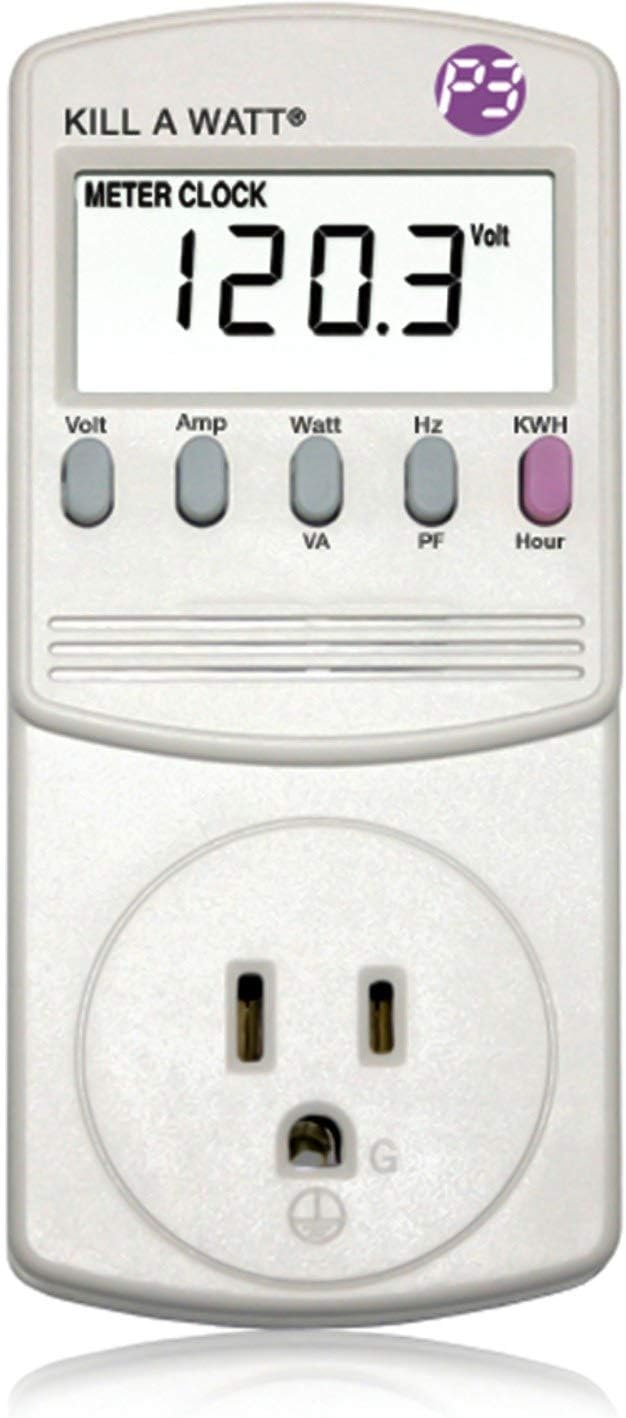
P3 P4400 Kill A Watt Monitor
- Plugs inline with a 120V compressor and reads true watts
- Totalises kWh, so you get loaded hours as well as power
- The cheapest way to find what a garage unit really costs

LE LEMATEC Regulator 0–150 PSI
- Regulate the one thirsty tool instead of the whole system
- Lets the header come down without starving the outlier
- The cheapest kilowatt is the one you never compress
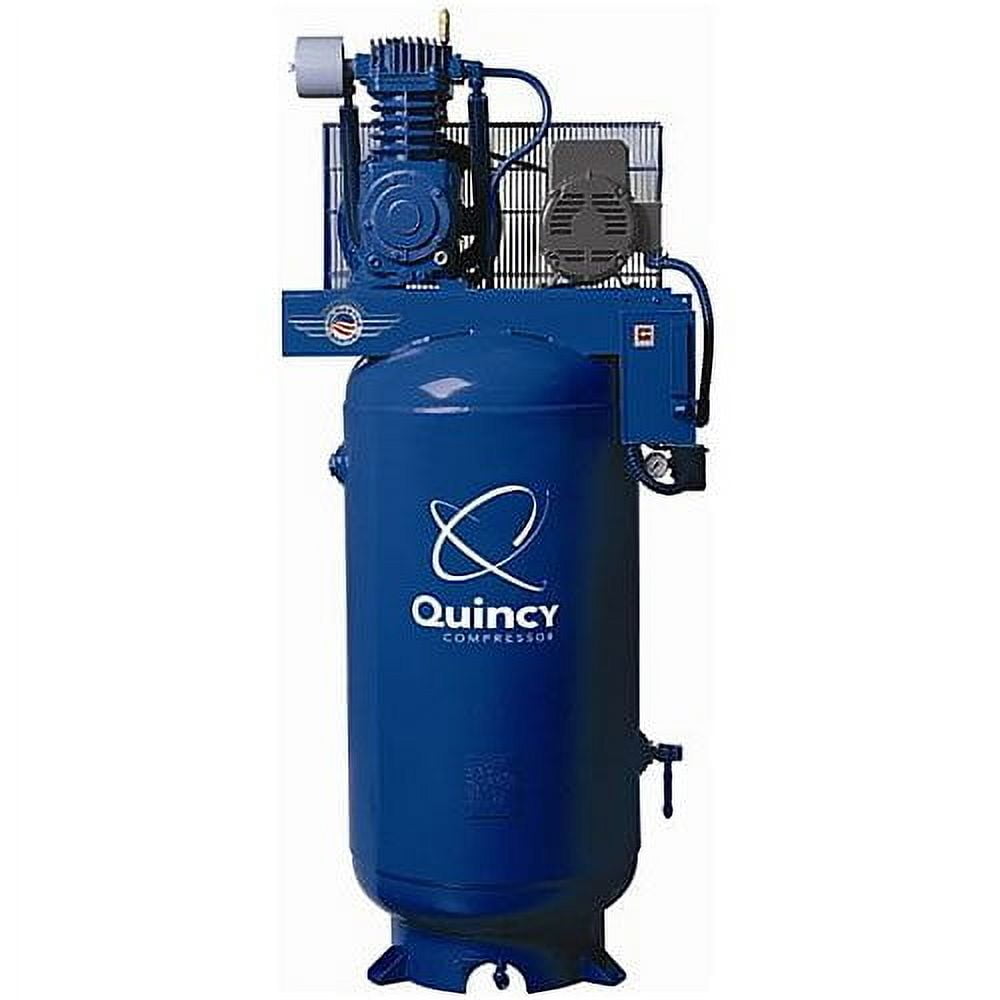
Quincy QT-7.5 Two-Stage Compressor
- Intercooled two-stage pump, the arrangement these pages explain
- 80-gallon receiver keeps the duty cycle honest
- Meter it when it arrives and you have a real baseline
As an Amazon Associate, TestTalkHQ earns from qualifying purchases. Prices and availability can change.
Symptoms, in the order the numbers move
The three measurements move differently depending on what is wrong, and the pattern usually identifies the cause before you open anything.
Capacity steady, power up → pressure setting raised, cooling problem, motor or drive fault
Both fine, machine never unloads → leaks or genuine demand growth, not an efficiency fault
Efficiency above 100% → bad input, not a machine at all
Measuring the capacity, when you have to
Half the diagnoses above depend on knowing whether the capacity has fallen, and capacity is the number nobody measures because it looks hard. On a machine with a receiver it is not especially hard.
Isolate the receiver from the plant, drain it, then time how long the compressor takes to raise it through a known pressure band. The air that went in is the volume of the receiver multiplied by the pressure rise in atmospheres, and dividing by the time gives you a delivery figure. It is rough — it ignores the temperature rise during the fill, the piping volume, and the fact that the machine is working across a changing pressure — but a machine that has lost 15% of its capacity will show it clearly, and that is the question you are asking.
The receiver arithmetic itself, and what the receiver is doing for the system, is covered by the air compressor tank size calculator.
Three faults that look identical on the bill
These get confused constantly, and the fix for each is different.
A worn machine
Specific power up, capacity down, power roughly unchanged, isentropic efficiency down. The machine is compressing the same air more than once because it leaks internally. Expensive to fix, and the least common of the three.
A leaking system
Specific power unchanged, isentropic efficiency unchanged, but the machine is loaded far more of the day than the work justifies. Nothing is wrong with the compressor at all — you are paying to compress air that goes straight back to atmosphere through fittings, hose ends and drain valves. This is the most common and the cheapest to attack.
An over-pressured system
Specific power up, isentropic efficiency roughly unchanged, capacity down. Raising the set pressure makes the machine work harder for less air, and it also increases the flow through every leak and every unregulated blow-off in the plant, so it costs twice. Free to fix if the plant does not need the pressure.
Leaks → efficiency unchanged, run time up → fix the fittings
Over-pressure → efficiency unchanged, specific power up → turn it down
Only the first of those is a compressor fault, and it is the one people reach for first.
What to fix first, by return
In rough order of kilowatts recovered per pound spent, across most small and mid-sized plants:
- Leaks. Almost always the biggest line and almost always the cheapest to attack. Nothing else on this list competes.
- System pressure. Free if the plant genuinely does not need what it is set to, and 16% is on the table between 175 and 125 psig.
- Inlet filter and inlet air temperature. Cheap, quick, and frequently the reason the machine looks worn.
- Unloaded running. Storage and control strategy, before hardware.
- Pipework. Undersized mains are often the reason the header pressure was raised in the first place.
- The machine itself. Last, and only once the efficiency has been measured rather than assumed.
The arithmetic that turns any of those kilowatts into money — load factor, running hours, tariff — is covered properly by the compressed air cost calculator, so it is not repeated here.