Nearly all of the electricity an air compressor draws comes back out as heat, and that heat has to be somewhere. There are only three places it can be: in the compressor room, outside the building, or somewhere in the building where you actually wanted heat. Most shops never make this decision consciously — they default to the first, discover in summer that the room is too hot, and default to the second. That is usually the right move in July and a straightforwardly expensive one in January. This is what each option is worth, what each one costs, and how to tell which you should be building.

What you are actually deciding about
Start with the size of the thing, because the decision looks different once the number is on the table. The Compressed Air and Gas Institute states it in its heat recovery technical brief: “Nearly 96% of the electrical energy consumed by an industrial air compressor is converted into heat, and usually that heat is simply ejected into the compressor room or ducted outside.”
That is not a compressor being inefficient. It is thermodynamics doing what it does: the energy that leaves as pressure in the air is a small share of the input, and it gets dissipated wherever the air is eventually used anyway. Everything else — compression heat pulled out by the aftercooler, oil cooler heat, motor and fan losses — lands in the air around the machine.
For a 25 hp air-cooled screw drawing about 20 kW, that is roughly 65,700 Btu/hr while it is running, which is about five and a half tons of cooling load. The same source gives the other number that makes this a real decision: “72% of the input energy is easily recovered from exhaust air through the coolers using ducting.” Nearly three-quarters of what you are paying the power company is available at the back of the machine as warm air, at a temperature CAGI puts at “30 °F to 40 °F higher (some up to 75 °F) than the cooling air inlet temperature.”
The three options, stated plainly
| Option | Heat left in the room | What it costs | What it is worth |
|---|---|---|---|
| A — leave it in the room | 96% of input power | Nothing, until the fan and louver it forces you to buy | Free heat in winter, if the room is somewhere you want heat |
| B — duct the cooler exhaust outside | About 24% | A duct and a roof or wall penetration | A much smaller exhaust fan and louver; a room that stops tripping |
| C — duct it into the building | About 24% | The same duct, plus distribution and a control | Displaced heating fuel for as long as the season lasts |
Notice what B and C have in common. Both are the same duct. The only difference is where the far end goes, and whether there is a damper deciding between them. That is why this decision so often resolves into “do both”, and why framing it as a binary choice leads people to build the wrong thing.
Option A — leave the heat in the room
Choose it when: the machine is small, the room is large or already well ventilated, the building needs heat for most of the year, and the compressor room is somewhere that benefits from being warm.
There is a real argument for A that people skip past. If the compressor lives inside a heated shop, the heat it dumps is not waste at all during the heating season — it is heat you would otherwise have bought. A 25 hp machine running through a winter afternoon is putting out about as much heat as a large commercial unit heater, for free, in a building that wanted it.
What it costs you: everything above is true until the outdoor temperature rises. Then the same heat has to leave through ventilation, and required airflow is inversely proportional to the temperature rise you are allowed. On that 25 hp machine with a 9 °F budget, option A needs roughly 6,800 CFM of exhaust and a gross intake louver of about 28 ft². Option B needs about a quarter of the airflow. The fan, the louver, the hole in the wall and the noise are all part of the price of option A, and they are paid up front.
Option B — duct the cooler exhaust outside
Choose it when: the room is overheating, the building is in a cooling-dominated climate, or the compressor is in conditioned space. It is also the right first move whenever the alternative is buying several thousand CFM of exhaust fan.
This is the cheapest large lever in compressor room design and it is the one people forget. Instead of diluting 65,700 Btu/hr with outdoor air, you collect it at the package discharge and send it out of the building. The room load falls to about 16,400 Btu/hr, the required room ventilation falls to roughly a quarter, and the louver shrinks with it.
What ducting a package actually involves
- The package fan has to push the duct. Compressor cooling fans are sized for the cooler, not for thirty feet of ductwork. Every manual gives a maximum allowable external static pressure — exceed it and you have quietly reduced the machine’s own cooling airflow, which is the opposite of what you set out to do. Short, straight, generously sized.
- Some machines need a booster fan in the duct. If the run is long or has bends, the manual will say so. Fit it and interlock it with the compressor, so the duct is never a dead end while the machine runs.
- The discharge has to go somewhere the intake cannot see. A roof discharge two feet from the intake louver is a recirculation loop with extra steps.
- Weather and backdraft. A duct straight to the outside world is a hole in the building: backdraft damper, a cowl, and something that stops it becoming a nesting site.
What it costs you: in winter, all of it. The 72% that CAGI says is easily recoverable is now being delivered to the car park, in a building that is simultaneously running a heater. This is the entire reason option C exists.
The instruments this job actually needs
Compressor room ventilation is one of the few shop problems where the diagnosis is genuinely a measurement rather than a judgement. Four readings settle almost every case: the air velocity at the louver, the temperature of the air going in, the temperature of the air coming out, and the current the machine is drawing. Fans and louvers themselves are selected from a curve and bought locally, so TestTalkHQ does not link them.
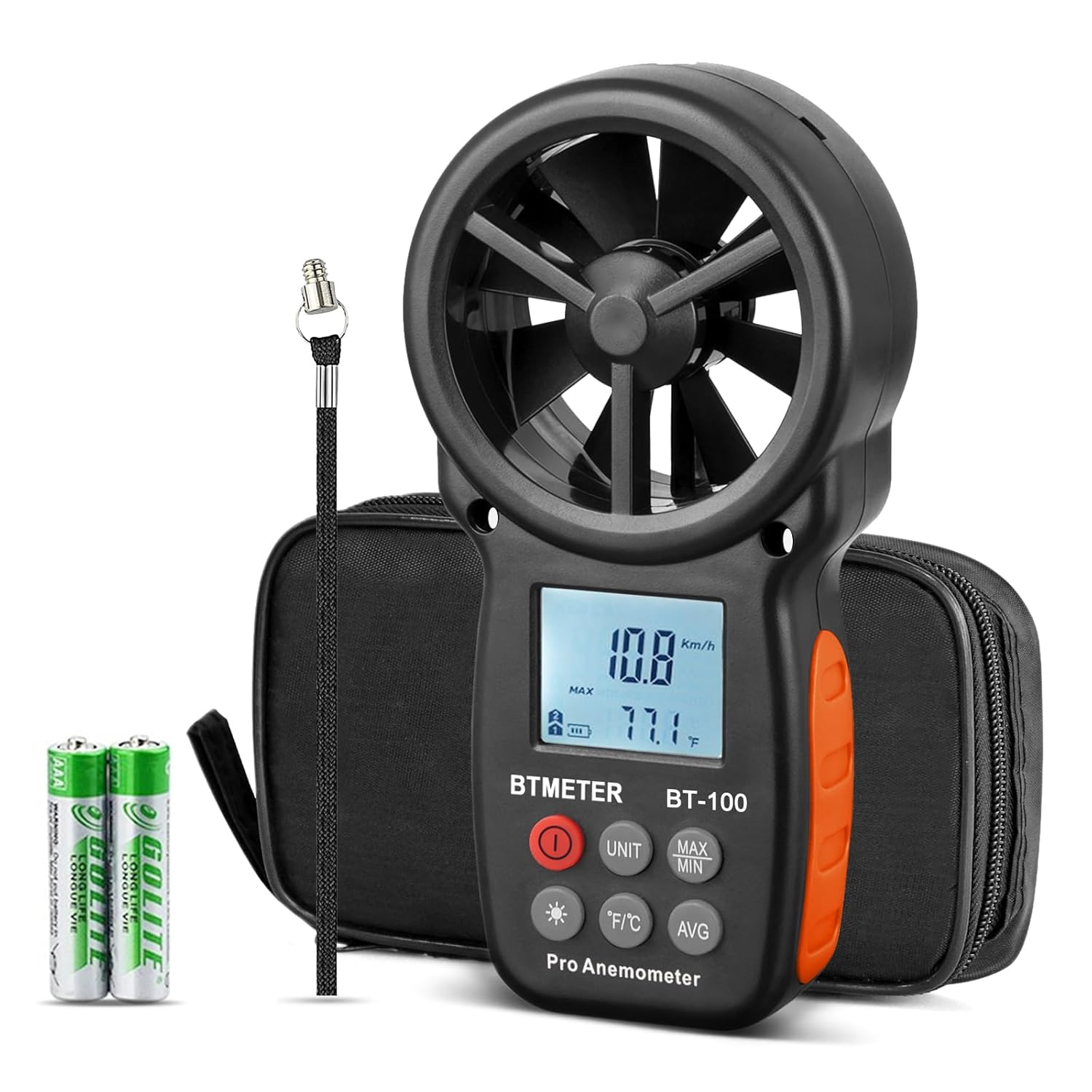
BTMETER BT-100 Handheld Anemometer
- Face velocity in fpm at the louver or the fan
- Velocity × free area is the CFM you really have
- The one reading that proves a fan is starved
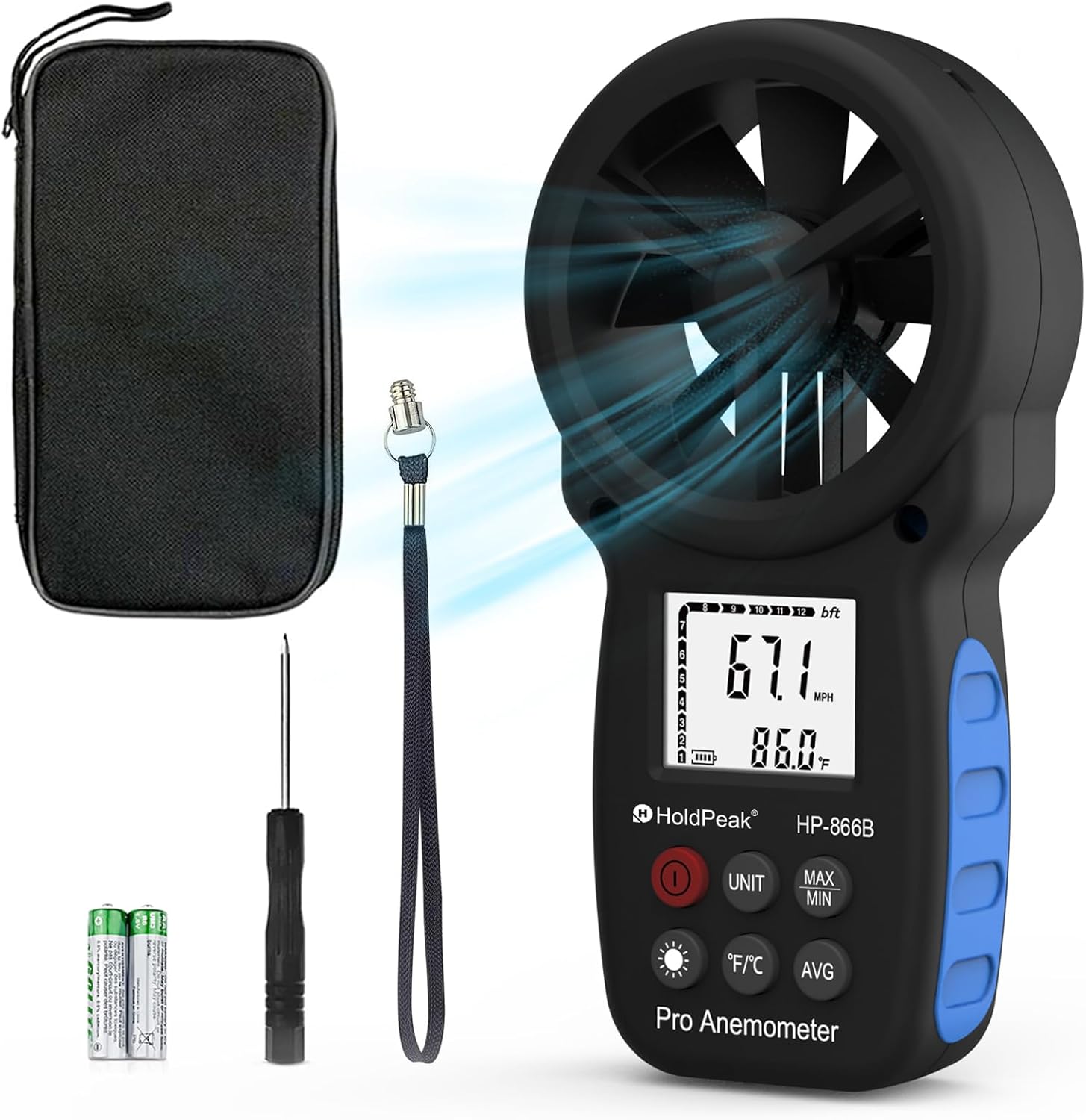
HoldPeak 866B Thermo-Anemometer
- Velocity and air temperature from one probe
- Intake and exhaust readings give you the real rise
- Cheap enough to leave in the plant room
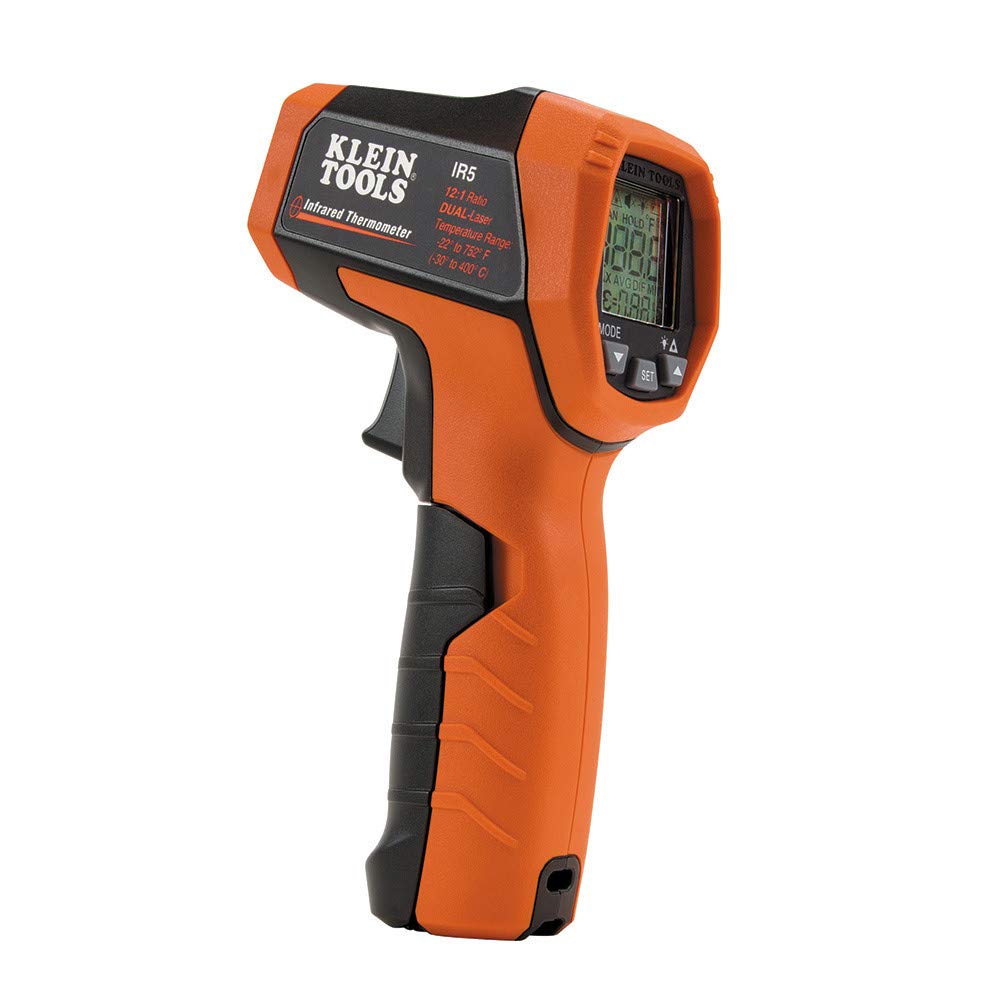
Klein Tools IR5 Infrared Thermometer
- Reads the cooler face and the enclosure without contact
- Traces a recirculation path around a packaged machine
- Dual laser keeps the spot where you aimed it
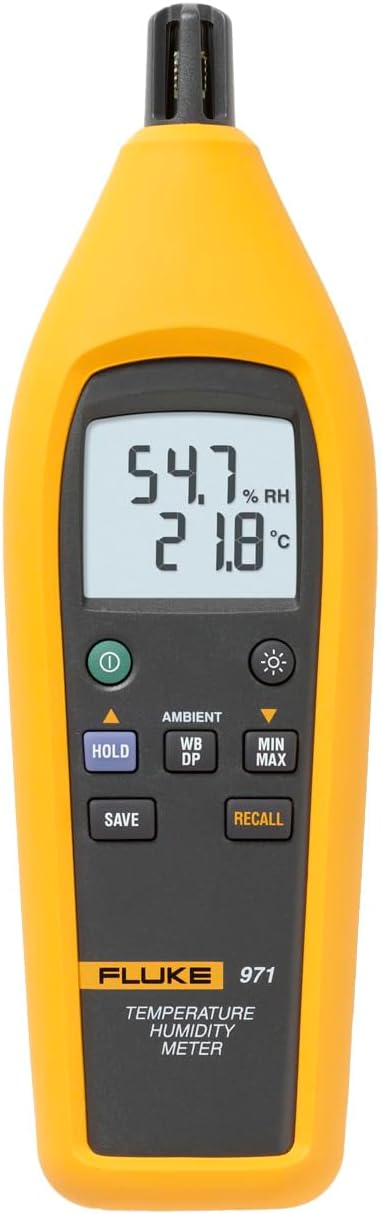
Fluke 971 Temperature / Humidity Meter
- Air temperature rather than surface temperature
- Log intake and room on the hottest afternoon of the year
- Humidity matters to the dryer sharing the room

Klein Tools CL800 Clamp Meter
- Loaded current beats a grossed-up nameplate every time
- Input power is the largest term in the heat balance
- Also settles arguments about real load factor
As an Amazon Associate, TestTalkHQ earns from qualifying purchases. Prices and availability can change.
Option C — recover the heat into the building
Choose it when: the building has a heating season of any length, and there is somewhere within a sensible duct run that wants warm air — a warehouse, a bay, a paint prep area, a loading dock, an office corridor.
CAGI’s heat recovery FAQ lists the usual destinations: warming production areas and warehouses, makeup air heating, air curtains, drying air for paint spraying, preheating combustion air, boiler makeup water, process heating and water heating. The warm-air route is by far the easiest, because it is standard HVAC ductwork and a thermostatically controlled damper — nothing exotic and nothing that touches the compressed air itself.
What it is worth, with the arithmetic shown
This is where the decision is usually won or lost, so do it with your own numbers rather than a percentage. For the 25 hp example:
Annual useful heat = rate × average load × hours the heat is genuinely wanted
Suppose the machine averages 60% load and there are about 1,000 hours a year when the building actually wants that heat and the compressor is running. That is 29.5 million Btu a year delivered, which is 295 therms — and because you are displacing a furnace that is not 100% efficient, at 80% AFUE it replaces about 369 therms of gas.
| What you are displacing | Annual value of the recovered heat |
|---|---|
| Natural gas at $1.00/therm (80% AFUE) | about $370 |
| Natural gas at $1.20/therm (80% AFUE) | about $440 |
| Natural gas at $1.60/therm (80% AFUE) | about $590 |
| Electric resistance heat at $0.12/kWh | about $1,040 |
| Electric resistance heat at $0.14/kWh | about $1,210 |
| Electric resistance heat at $0.18/kWh | about $1,560 |
Those numbers tell you something important that a percentage never would: what the recovered heat is worth depends far more on what you are displacing than on the compressor. Displacing cheap natural gas on a 25 hp machine buys you a few hundred dollars a year, which pays for a duct and a damper and not much more. Displacing electric resistance heat — or heating a space that currently has no heat at all and where people are cold — is a different conversation entirely.
And scale drives it hard. CAGI is blunt about this: “Generally, the larger the compressor system the faster the payback of a heat recovery process.” Run the same arithmetic on a 100 hp machine and every figure above multiplies by about four, while the duct does not.
The water-heating route
Warm air is easy and low-grade. Heating water or process fluid is worth more per Btu and is harder to retrofit. CAGI notes that it can be done on either machine type, “although the best efficiencies are usually obtained from water-cooled compressor installations where the hot, discharge cooling water is connected directly to the process heating application”, and that reheating boiler return water is an application that earns year-round rather than seasonally — which removes the biggest weakness of the warm-air route. Some manufacturers offer factory heat-recovery exchangers as a package option, which is nearly always cheaper than engineering one on site. If food, pharmaceutical or potable water is involved, CAGI’s guidance is to specify a fail-safe (double-wall) exchanger so compressor lubricant cannot cross into the process fluid.
Which to use
| Your situation | Build this | Why |
|---|---|---|
| Small machine, big cool room, no overheating | A — leave it | Nothing is broken. Spend the money elsewhere. |
| Room overheats, cooling-dominated climate | B — duct out | Cheapest fix by a distance, and it shrinks the fan and louver you would otherwise buy. |
| Compressor inside conditioned space | B or C, never A | You are paying twice: once to make the heat and once to remove it. |
| Real heating season, electric or expensive heat | C, with a summer bypass | Displaced heating cost is the largest number on the table. |
| Real heating season, cheap gas, small machine | B, with a winter damper into the shop | Get the cooling benefit first; take the heating benefit for the cost of one damper. |
| Large machine, any climate | C, and look at water too | Scale is what makes recovery pay, and water-side recovery earns year-round. |
| Machine short-cycles or runs mostly unloaded | Fix the controls first | Recovering heat from air you did not need to make is solving the wrong problem — see the compressed air cost calculator. |
The answer most shops should actually build
Not a choice — a damper. One duct off the package’s cooler discharge, splitting into two paths: one to outside, one into the building. A thermostatically controlled motorised damper sends the heat where the season wants it. CAGI describes exactly this arrangement: “Space heating is easily regulated by using thermostatically controlled, motorized louver flaps to make continuous adjustments to the heating air flow to maintain consistent room temperature. This also means that when heating is not required, the hot air can be ducted outside the building to reduce cooling costs.”
The incremental cost over option B is one damper, one actuator and a thermostat. The incremental benefit is the whole of the table above for as many hours as your heating season lasts. For most shops that is the highest return on any part of this decision, which is why a straight A-versus-B framing tends to produce the wrong building.
What goes wrong with each of these
With ducting out
- Too much duct for the package fan. The most common failure, and it is silent: the machine’s cooling airflow drops, the package runs hotter, and everyone blames the room. Check the manual’s maximum external static pressure before designing the run.
- Discharge where the intake can see it. A recirculation loop built on purpose.
- No backdraft damper. In winter the duct becomes a cold draught straight into the plant room, which can push a refrigerated dryer below its minimum ambient and freeze condensate drains.
With heat recovery
- Counting hours the heat is not wanted. The value depends on hours when the compressor is running and the building wants heat. Those two overlap less than a spreadsheet assumes, especially on a single-shift operation.
- Dumping compressor-room air into an occupied space. It carries the plant room’s noise, dust and any oil mist with it. Filter it, and think about where it discharges.
- No summer path. A recovery duct with no bypass is an overheating problem waiting for June.
- Retrofitting fluid recovery onto a small air-cooled machine. CAGI is direct about this: on a small unenclosed piston compressor, “it will be difficult to capture the heat”, and after installation costs smaller systems may not produce enough recoverable energy to be worth it.
Frequently asked questions
How much heat can you actually recover from an air compressor?
CAGI puts 96% of the electrical energy as converted to heat, and 72% of input energy as easily recovered from the cooler exhaust by ducting, with recovery efficiencies of up to 90% frequently attained on fluid-to-fluid systems. The practical figure for a warm-air duct on an air-cooled screw is around that 72%, and the limit on what it is worth is almost never the compressor — it is how many hours the building genuinely wants the heat.
Is compressor heat hot enough to be useful?
For space heating, yes. CAGI puts cooler discharge air at 30–40 °F above the inlet air temperature, and some machines up to 75 °F above, which on a 70 °F plant room is air in the 100–145 °F range — comparable to what a unit heater delivers. Oil-free screws run hotter still, with discharge temperatures CAGI puts as high as 300 °F or more, which opens up higher-grade uses.
Does ducting the exhaust reduce the compressor’s performance?
Only if the duct is too restrictive for the package fan. Every manual states a maximum allowable external static pressure for the cooling air discharge; stay inside it, keep the run short and straight, size it generously, and fit the booster fan the manual asks for on longer runs. Done properly it does not affect the machine; done badly it reduces the machine’s own cooling airflow and makes the problem you were fixing worse.
Should I duct the compressor’s intake to outside air as well?
It is usually worth it, and it is a separate duct from the cooler exhaust. Cooler intake air is denser, so the machine delivers more air for the same power — DOE’s Tip Sheet #14 recommends locating the inlet pipe outside the room or building for exactly this reason, with two cautions: size the pipe up on long runs so inlet pressure drop does not throttle the machine, and think about what the termination will inhale.
Is heat recovery worth it on a 5 or 10 hp shop compressor?
As an engineered project, rarely. As a duct and a damper on a machine that is already overheating its cupboard, often — because you were going to have to move that air anyway, and pointing it at the shop instead of the car park in winter costs almost nothing extra. The formal payback arithmetic starts working when the machine is large and runs long hours; CAGI’s own guidance is that the larger the system, the faster the payback.
What about the dryer — does recovering heat affect it?
Indirectly, and in the right direction. Anything that stops the compressor room heating up helps a refrigerated dryer, because its capacity falls as its ambient rises. The one thing to avoid is the opposite mistake: a winter recovery duct with no backdraft damper, drawing cold outside air back into the plant room and taking the dryer below its minimum ambient. Both ends of the range matter.