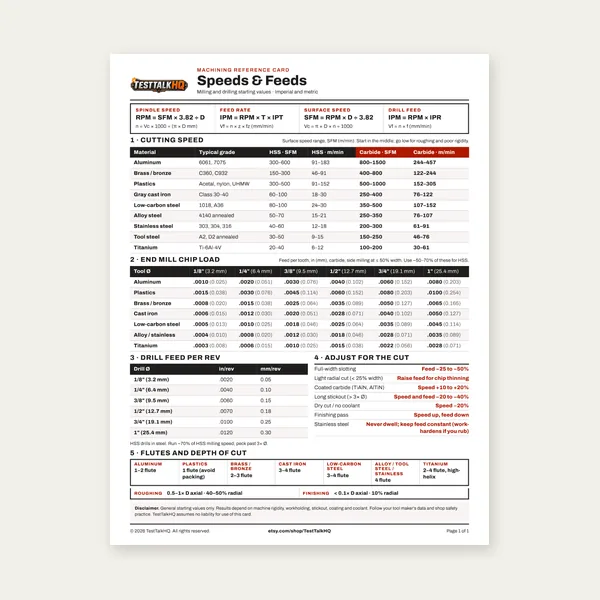
Machining Speeds & Feeds Card
One page. Speeds, chip load and drill feed, imperial and metric.
$3.99
BuyAccuracy, cost, speed, and when the shop needs each
Both tools set or check angles. One is geometry you can trust to gauge-block standards; the other is a fast electronic readout. Pick based on tolerance, time, and whether the angle must hold under a cut.
| Factor | Sine Bar + Gauge Blocks | Digital Angle Gauge |
|---|---|---|
| Accuracy class | Arc-minute / better when stack and plate are controlled | Typically ±0.1° to ±0.2° (check the spec sheet) |
| Setup time | Minutes — clean, wring, mic, seat | Seconds — zero and place |
| Cost to enter | Bar + set + plate (higher) | Low for a magnetic cube gauge |
| Best use | Inspection masters, grind/mill sine plate setups | Fixture rough-in, weldment checks, non-critical miters |
| Failure modes | Wringing, dirt, thermal, worn rollers | Wrong zero, low battery, magnetic base slip, resolution limit |
Reach for the sine bar when the print calls out angles in minutes, when a grind or mill pass must land on a master angle, or when you are qualifying a fixture that other jobs will copy. The method ties the angle to length standards your shop already trusts.
Use the Sine Bar Angle Calculator to get H and a block suggestion, then follow the setup guide for wringing and plate technique.
Digital gauges win on speed: checking a pressed brake angle, roughing a sine plate before final blocks, verifying a weldment bevel, or setting a band saw. If the tolerance is ±0.5° or looser, chasing gauge blocks is wasted time.
Watch the resolution marketing. A display that shows 0.05° is not the same as an instrument that is accurate to 0.05°. Zero on a known reference and re-check often.
A decent magnetic digital gauge is cheap and almost anyone can use it. A sine bar program needs a block set, plate discipline, and people who will mic stacks instead of guessing. If your shop only owns a digital gauge, buy blocks before you promise arc-minute work on the floor.
Angular error in assemblies often interacts with linear tolerances — pair this decision with the Tolerance Stack-Up Calculator when fit depends on both.
Building the stack?Get height and block suggestions in one step.
Open Calculator →Not for master angles and critical grind setups. It can replace them for a large share of shop checks where tolerance is open.
Clean and rebuild the sine setup first. Then zero the digital on the sine bar face. Persistent disagreement means one instrument needs calibration — see Sine Bar Troubleshooting.
One page. Speeds, chip load and drill feed, imperial and metric.
$3.99
Buy
27 pages. Milling, drilling, tapping, turning and CNC routing.
$12.99
Buy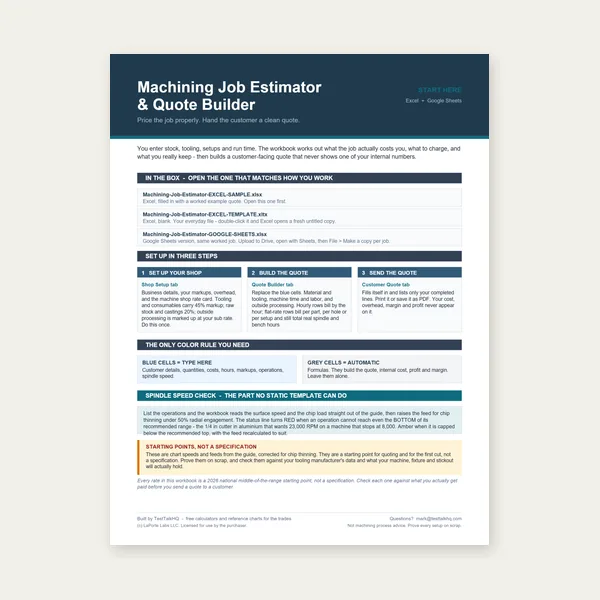
Quote shop work and check operations against your spindle's top speed.
Excel or Google Sheets. Best on a computer.
$29.00
Buy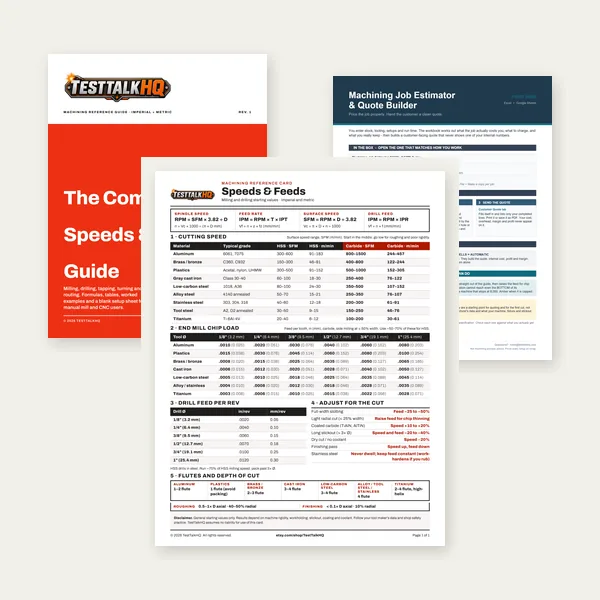
Card, 27-page guide and the estimator workbook. All six files.
Excel or Google Sheets. Best on a computer.
$34.99
$45.98 if bought separately — save $10.99
BuyCheckout opens in a new tab.