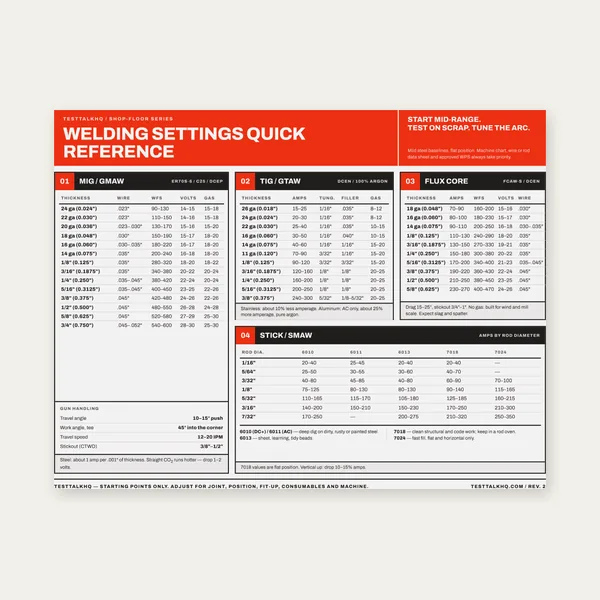
Welding Reference Card
One page. MIG, TIG, stick and flux core settings by thickness.
$3.99
BuyMild steel, galvanized, stainless, and aluminum spot weld settings
Resistance spot welding settings for mild steel, galvanized, stainless, and aluminum — current, weld time, electrode force, and tip geometry explained for the shop floor.
Spot welding is resistance welding. You clamp two (or more) sheets between copper alloy electrodes, pass a short burst of high current through the stack, and the joint heats where electrical resistance is highest — at the faying surfaces. The physics is Q = I²Rt: heat equals current squared, times resistance, times time. Double the current and you quadruple the heat. That is why amperage is the most sensitive variable on the machine.
The three variables you control: Current in kiloamps (kA) — typically 7–14 kA for steel sheet, 20–35 kA for aluminum. Weld time in AC cycles (one cycle = 1/60 second at 60 Hz) or milliseconds. Electrode force in pounds or kilonewtons — squeezes the sheets together so current flows through the joint, not around it. Too little force and you get arcing at the surface. Too much and you crush the nugget and leave deep indentations.
Nugget formation: A good spot weld produces a lens-shaped fusion zone — the nugget — between the sheets. On a peel or chisel test, the nugget should pull from one sheet and leave a hole in the other, not pop out as a button with no fusion. A cold weld shows a small or missing nugget — current or time too low, poor fit-up, or oily surface. Expulsion — molten metal squirting from the joint — means too much heat: current too high, time too long, or force too low. You want a clean ring around the weld face, not spatter on the floor.
Why spot over MIG on sheet metal: No filler wire, no shielding gas, no grinding. A pneumatic gun puts a weld in under a second. On auto body and production lines, that speed and repeatability beat arc welding for lap joints in gauge material. MIG still wins on access, thickness range, and repair work where you cannot reach both sides — but for repetitive sheet lap joints, spot is the process.
Mild steel is the most forgiving material. Wide current and time windows, Class 2 copper-chromium electrodes, flat or truncated-cone tips. Thicker gauge needs more current, longer time, and higher force — but the relationship is not linear. Jumping from 18 ga to 12 ga is a bigger settings change than 18 ga to 16 ga.
Galvanized steel needs 10–15% higher current than bare mild steel at the same thickness. Zinc melts and alloys at the surface, increasing contact resistance early in the pulse — then the zinc contaminates your electrode faces. Expect faster mushrooming and pitting. Dress electrodes more often and never run production galv on electrodes you need for cosmetic bare steel work.
Stainless steel has lower thermal conductivity than carbon steel — heat stays in the nugget instead of conducting away into the sheets. Reduce current 20–25% and shorten weld time 15–20% compared to mild steel at the same gauge, or you will expel. Higher force helps contact. Use dedicated stainless electrodes or accept shorter dress intervals — do not cross-contaminate with mild steel tips.
Aluminum conducts heat and electricity roughly three times better than steel. You need 2–3× the current, roughly one-quarter the weld time, and dome-face Class 1 electrodes (RWMA Group A — higher conductivity, softer). Flat tips on aluminum stick and gall. Even with correct settings, aluminum spot welding is unforgiving — surface oxide, fit-up, and electrode condition matter more than on steel.
Never mix electrode types between materials. Steel contamination on aluminum tips ruins the weld. Aluminum smeared on steel tips causes unpredictable resistance. Label your guns and keep a dedicated electrode set for each material family.
Starting values for two-sheet lap joints on a 60 Hz machine. Adjust for your equipment, fit-up, and coating. Hold time is post-weld force before electrodes open — lets the nugget solidify under pressure.
| Material | Thickness | Current (kA) | Weld Time (cycles) | Hold Time (cycles) | Electrode Force (lbs) | Electrode Tip Ø (mm) |
|---|---|---|---|---|---|---|
| Mild steel | 18 ga (0.048") | 9.0 | 10 | 6 | 450 | 5.5 |
| Mild steel | 16 ga (0.060") | 10.5 | 12 | 8 | 550 | 6.0 |
| Mild steel | 14 ga (0.075") | 11.5 | 15 | 10 | 700 | 6.5 |
| Mild steel | 12 ga (0.105") | 13.0 | 18 | 12 | 900 | 7.5 |
| Galvanized | 18 ga | 10.2 | 11 | 7 | 480 | 5.5 |
| Galvanized | 16 ga | 12.0 | 13 | 9 | 580 | 6.0 |
| Stainless steel | 18 ga | 7.0 | 8 | 6 | 480 | 5.0 |
| Stainless steel | 16 ga | 8.5 | 10 | 8 | 580 | 5.5 |
| Aluminum | 0.040" | 20.0 | 3 | 4 | 450 | 9.0 (dome) |
| Aluminum | 0.063" | 25.0 | 4 | 5 | 550 | 10.0 (dome) |
| Aluminum | 0.090" | 30.0 | 5 | 6 | 700 | 11.0 (dome) |
For three-sheet stacks, increase current 15–20% and weld time 20–25% over the two-sheet values. Use the Spot Welding Calculator for stack-adjusted settings by material and machine type.
Class 2 copper-chromium (RWMA Group A, C18200) is the standard for steel and stainless spot welding. Good hardness at weld temperature, reasonable conductivity, handles the duty cycle of production guns. Class 1 copper-zirconium (C15000) is softer and more conductive — use it for aluminum and high-heat-transfer applications where Class 2 would overheat.
Tip geometry: Flat face for mild and stainless steel — maximum contact area, predictable current density. Truncated cone for galvanized and general steel when you need slightly higher current density at the center. Dome face for aluminum — reduces sticking and helps break surface oxide at initial contact. Match tip diameter to thickness — undersized tips burn through; oversized tips spread current and produce undersized nuggets.
When to dress vs replace: Dress when the face mushrooms or pits — file or cut back to flat (steel) or re-radius the dome (aluminum). Replace when face diameter grows more than 20% over spec, when pitting cannot be dressed out, or when the tip length is too short to reach into the holder. A mushroomed 6 mm tip that measures 8 mm behaves like a different weld schedule — current density drops and nuggets shrink.
Rule of thumb: Dress every 50–100 welds on bare steel, every 25–50 welds on galvanized or aluminum. Log dress cycles on production jobs. Electrode maintenance is not optional — it is half the process.
Cold weld (no nugget): Current too low, weld time too short, poor fit-up with gap between sheets, oily or painted faying surfaces, or worn electrodes with too large a face. Fix: increase current in 5–10% steps, add time one cycle at a time, clean surfaces, check gun alignment and force.
Expulsion / spatter: Current too high, time too long, force too low, or electrodes too small for the heat input. Fix: back off current first, shorten time, increase force, dress mushroomed tips.
Surface marks / deep indentation: Force too high, tip diameter too small, or misaligned electrodes causing edge loading. Fix: reduce force within the schedule range, use correct tip size, align gun arms and check equal electrode stick-out.
Electrode sticking: Current too high, hold time too short (nugget not fully solidified before release), or wrong tip geometry for the material — flat tips on aluminum stick constantly. Fix: reduce current slightly, add hold time, switch to dome tips on aluminum, dress contaminated faces.
Porosity in nugget: Surface contamination — oil, rust, zinc vapor entrapment on galvanized, or welding through sealers without removing them from the faying surface. Fix: clean the joint, grind sealer from the weld zone, increase force to close gaps before the current pulse.
OEM vs repair spot welding: Factory welds use servo guns with closed-loop force and current control, precise tip geometry, and weld monitoring on every pulse. Repair shop guns are often pneumatic with less feedback — your settings are starting points, not copy-paste from the OEM schedule. Factory welds also land on clean, controlled-thickness stampings with designed flanges. Repair work hits mixed gauges, sealer, and access constraints. Expect to tune.
Weld spacing: Minimum center-to-center distance is 3× nugget diameter. Closer spacing shunts current through the previous weld instead of making a new nugget. On a typical 5 mm nugget, stay 15 mm (5/8") minimum between weld centers — more on high-strength steels where HAZ overlap weakens the panel.
Stack welding: Three-layer joints — outer panel, reinforcement, inner panel — need higher current and longer time than two-sheet values. The middle sheet is the heat sink. Increase current 15–20% and time 20–25% over two-sheet settings, verify nugget size in all three interfaces with a destructive peel test on scrap.
Run your material, thickness, stack count, and machine type through the Spot Welding Calculator for current, time, force, nugget size, and minimum spacing before you start production welds.
Start at 9 kA with 10 cycles weld time and 6 cycles hold time on a 60 Hz machine, at roughly 450 lbs electrode force and a 5.5 mm flat-face Class 2 tip. Adjust in small steps — increase current 5–10% if the nugget is undersized, decrease if you get expulsion.
Aluminum spot welding needs dome-face Class 1 electrodes, very high current, and short weld time. Flat steel tips gall and stick on aluminum. Also check hold time — opening the electrodes before the nugget solidifies causes sticking. Dress or replace contaminated tips and never use aluminum-dedicated tips on steel.
Minimum spacing is 3× the nugget diameter center-to-center. A 5 mm nugget needs at least 15 mm between weld centers. Closer spacing causes current to shunt through the previous weld, producing cold or missing nuggets. OEM flange designs often space welds 20–30 mm apart — match the factory pattern when possible.
Weld time is when current flows and the nugget forms — typically 3–18 cycles depending on material. Hold time is after current shuts off but before electrodes open; full force remains on the joint while the nugget solidifies. Too short a hold time causes sticking and cracked nuggets. Hold time is usually 40–60% of weld time on steel, slightly longer on aluminum.
One page. MIG, TIG, stick and flux core settings by thickness.
$3.99
Buy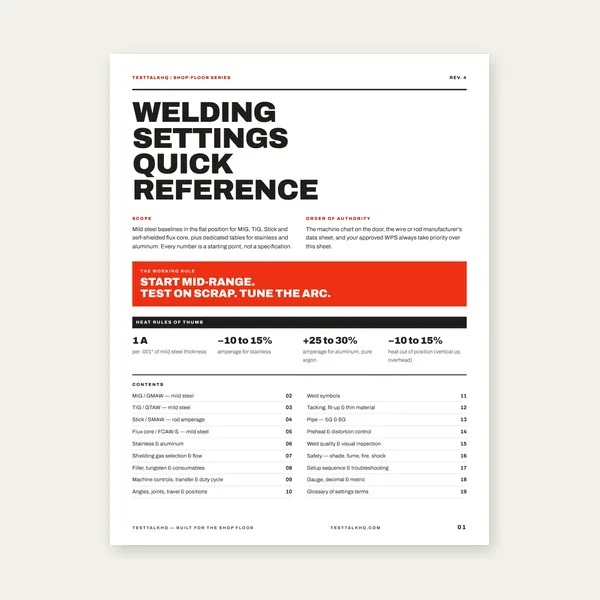
19 pages. Four processes, stainless and aluminum, symbols and inspection.
$12.99
Buy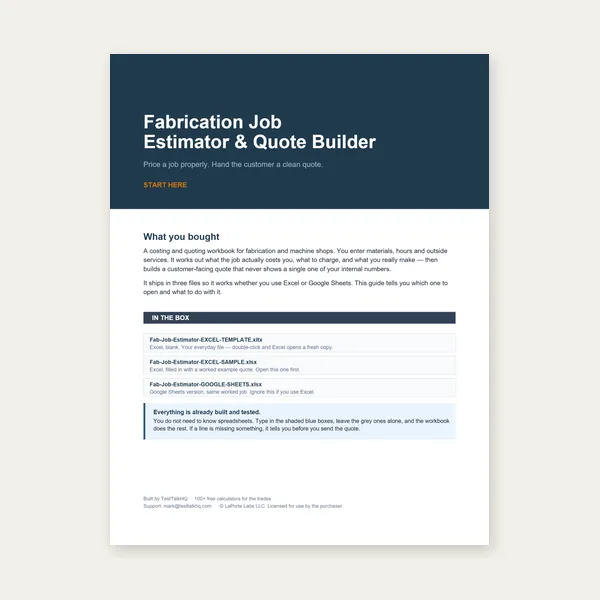
Price the job, then hand over a quote with no internal numbers.
Excel or Google Sheets. Best on a computer.
$29.00
Buy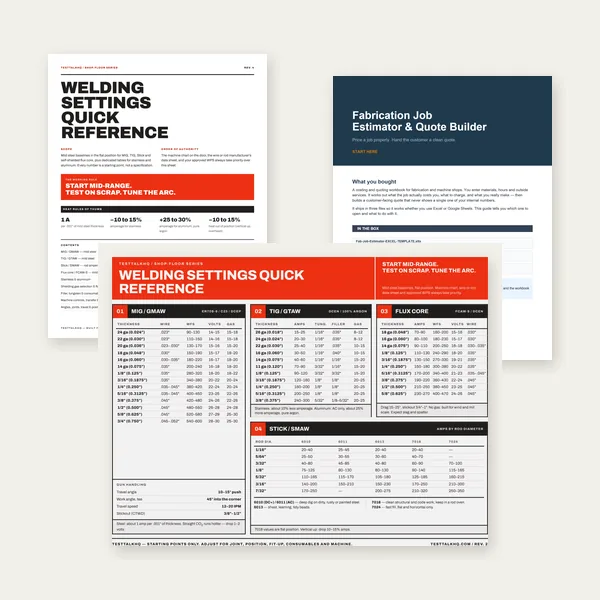
Card, 19-page guide and the estimator workbook. All six files.
Excel or Google Sheets. Best on a computer.
$34.99
$45.98 if bought separately — save $10.99
BuyCheckout opens in a new tab.