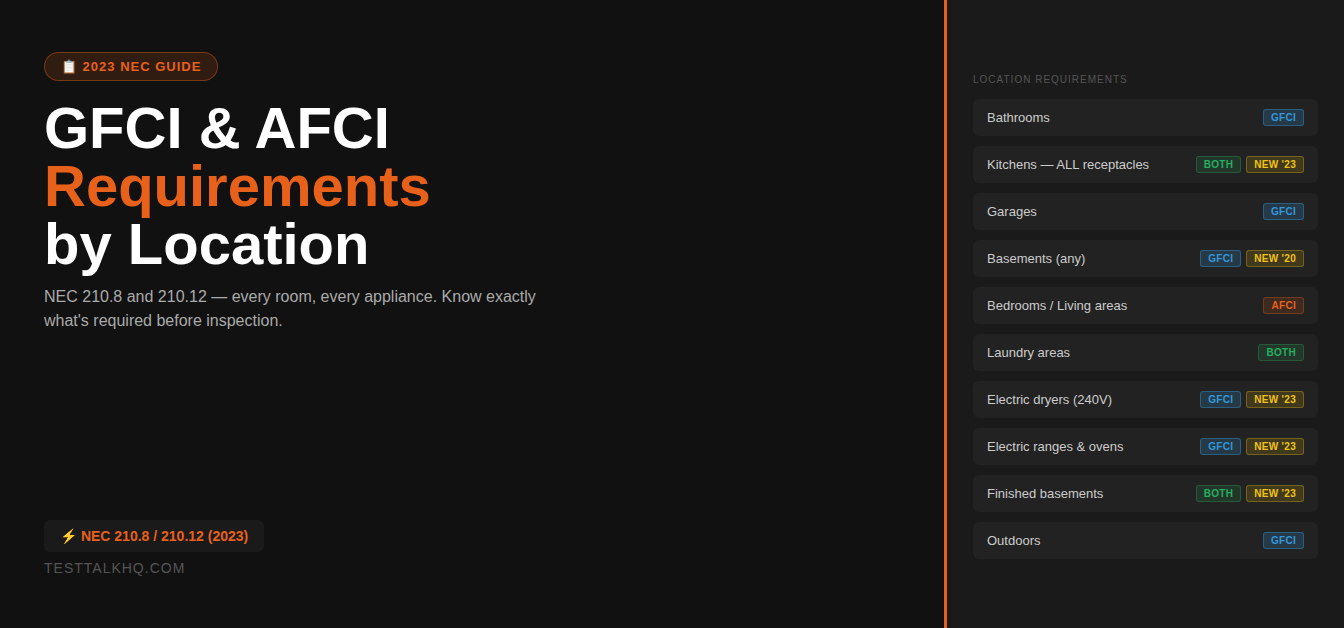
Fast answer: GFCI protects people from shock hazards, AFCI helps reduce arc-fault fire hazards, and some locations require both. Kitchens, laundry areas, and finished basement living spaces are the most common places where people miss dual protection requirements.
This page is a practical location guide, not a permit shortcut. Use it with the Circuit Breaker Sizing Calculator, Wire Ampacity & Derating Calculator, Voltage Drop Calculator, and Panel Schedule Calculator when planning circuits and panel layouts.
Circuit Breaker Types Explained
Wire Ampacity Calculator
Voltage Drop Calculator
Panel Schedule Calculator
Free Calculators & Tools
GFCI vs AFCI Quick Answer
Use this location chart for fast field checks, then verify against your adopted NEC edition and local amendments.
| Location | GFCI | AFCI | Notes |
|---|---|---|---|
| Bathroom | Yes | No (typical) | Bathroom receptacles are GFCI-required locations |
| Kitchen | Yes | Yes | 2023 NEC expands kitchen GFCI; AFCI also applies in dwelling kitchens |
| Garage | Yes | No (typical) | All receptacles commonly require GFCI in garage areas |
| Basement (finished) | Yes | Yes (habitable space) | Often dual-function breaker territory |
| Laundry area | Yes | Yes | Dual protection commonly required in modern editions |
| Outdoor receptacles | Yes | No (typical) | GFCI is key for weather-exposed locations |
| Bedroom | No (typical) | Yes | AFCI is a core dwelling-space requirement |
| Living / Dining / Hall | No (typical) | Yes | AFCI applies in most habitable interior areas |
| Dedicated appliance circuits | Depends | Depends | 2023 appliance changes expanded some GFCI requirements |
Need the numbers, not the lecture?
Use the calculators below when you want breaker sizing, wire sizing, voltage drop, or panel schedule help without guessing.
What GFCI Protects
GFCI devices are shock protection devices. They monitor imbalance between outgoing and returning current and trip fast when current leaks to an unintended path.
What AFCI Protects
AFCI devices target arc-fault patterns associated with wiring damage, loose connections, and other conditions that can start fires inside finished spaces.
GFCI Requirements — NEC 210.8 (Dwelling Units)
| Location | Protection | Notes |
|---|---|---|
| Bathrooms | GFCI | All bathroom receptacles |
| Garages and accessory buildings | GFCI | All receptacles |
| Outdoors | GFCI | Exterior receptacles and related outdoor points |
| Crawl spaces | GFCI | At or below grade areas |
| Basements | GFCI | Modern code editions expanded coverage |
| Kitchens | GFCI | 2023 edition broadens kitchen receptacle scope |
| Laundry areas | GFCI | Laundry receptacles included |
| Within 6 ft of sink | GFCI | Distance-based rule applies by code method |
| Dishwashers / dryers / ranges / ovens | GFCI in 2023 contexts | Appliance rules changed in recent editions |
AFCI Requirements — NEC 210.12 (Dwelling Units)
| Location | Protection Required | Notes |
|---|---|---|
| Bedrooms | AFCI | Long-standing AFCI location |
| Living, family, dining, hall, closets | AFCI | Habitable space coverage expanded in newer editions |
| Kitchens | Both | AFCI + GFCI where both location rules apply |
| Laundry areas | Both | Common dual-protection application |
| Finished basement habitable areas | Both | Often requires dual-function strategy |
| Bathrooms / Garages / Outdoor | Usually GFCI-focused | Not typically AFCI list entries; verify local adoption |
Kitchen Requirements
Kitchens are one of the easiest places to fail inspection because both protection types often overlap. Receptacle scope and edition changes matter.
Bathroom Requirements
Bathroom receptacles are GFCI territory. Do not assume AFCI automatically substitutes where GFCI is required.
Garage and Basement Requirements
Garage receptacles are a recurring GFCI miss. Finished basements can trigger both GFCI and AFCI requirements depending on area use and local adoption.
Outdoor Requirements
Outdoor receptacles are commonly GFCI-required and can include equipment-adjacent locations depending on edition and exceptions.
Bedroom and Living Area Requirements
Habitable interior areas are generally AFCI-driven. Keep circuit mapping clear so protection type and device location are traceable at inspection.
GFCI + AFCI Together (Dual-Function Strategy)
When both are required, dual-function breakers are often the cleanest route for panel space and inspection clarity.
Common Mistakes
| Mistake | Why It Fails | Better Approach |
|---|---|---|
| Assuming AFCI replaces GFCI | Different hazards and code sections | Match protection type to location requirement |
| Ignoring NEC edition differences | Requirements changed in 2020/2023 updates | Verify adopted code with AHJ before permit closeout |
| Treating replacement device work as full upgrade | Scope and local rules vary | Confirm what triggers broader compliance updates |
| Missing kitchen/laundry dual protection | Overlapping rules frequently apply | Use dual-function breakers where appropriate |
Frequently Asked Questions
What is the difference between GFCI and AFCI?
GFCI targets shock-risk ground faults. AFCI targets dangerous arcing associated with fire risk.
Where are GFCI outlets required?
Commonly in wet/damp and location-specific areas such as bathrooms, kitchens, garages, outdoors, laundry, and related locations per adopted code.
Where are AFCI breakers required?
Typically in many habitable dwelling areas such as bedrooms and living spaces, with additional overlap zones in modern editions.
Do kitchens need both GFCI and AFCI?
In many modern-code contexts, yes. Verify your local NEC adoption and inspector interpretation.
Do bathrooms need AFCI protection?
Bathrooms are typically GFCI-focused locations; AFCI scope is usually centered on habitable interior spaces.
Do garages need GFCI protection?
Yes, garage receptacles are a frequent GFCI inspection item.
Do outdoor outlets need GFCI protection?
Yes, outdoor receptacles are commonly GFCI-required locations.
Can one breaker provide both GFCI and AFCI protection?
Yes, dual-function breakers can provide both where required.
Is a GFCI outlet the same as a GFCI breaker?
Both can provide GFCI protection, but coverage and installation strategy differ by circuit layout.
Do older homes need to be upgraded?
Upgrade triggers depend on scope of work and local enforcement. Always confirm requirements with your AHJ.
Conclusion: Match Protection to Location and Code Edition
The fastest way to stay out of trouble is simple: identify the location, confirm the adopted NEC edition, and apply the right protection type (or both). Use the calculators below to support breaker, conductor, voltage-drop, and panel decisions before final installation.
Any trade

Contractor Job Estimator
Price remodels and GC work, then send a quote with no internal numbers.
Excel or Google Sheets. Best on a computer.
$29.00
BuyCheckout opens in a new tab.