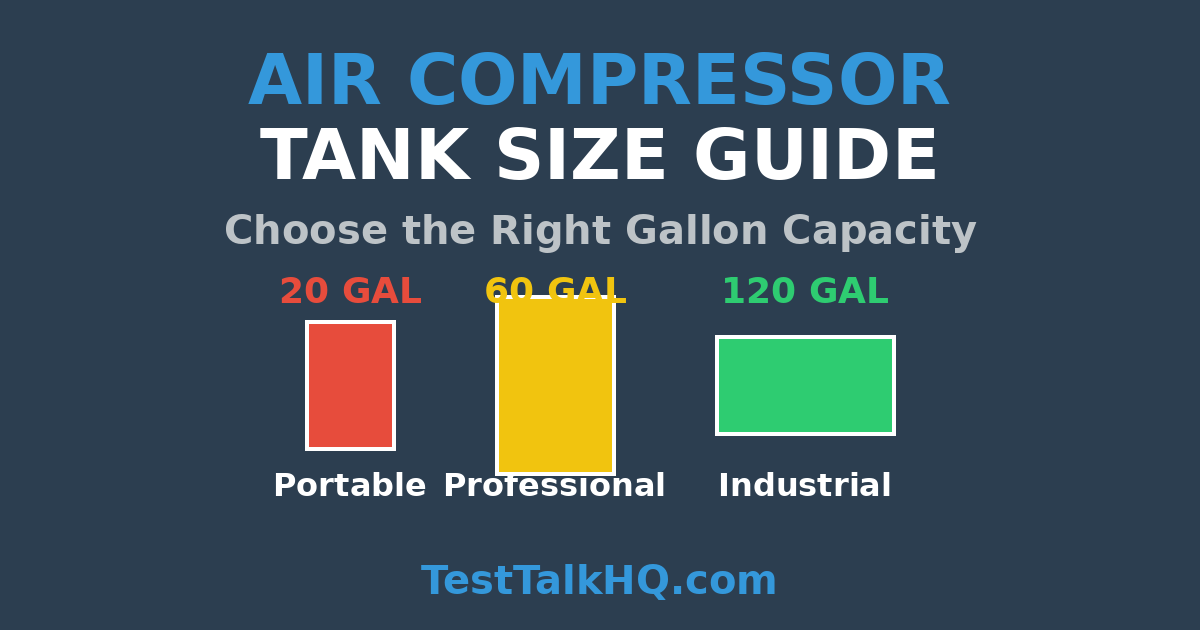
A 60-gallon air compressor sounds like it holds twice as much air as a 30-gallon tank—but if both deliver the same CFM (cubic feet per minute), the larger tank only buys you a few extra minutes before refilling. This is why choosing air compressor tank size based solely on gallon capacity leads to frustration: you either buy more tank than you need and waste money, or you buy too little and spend half your day waiting for the compressor to catch up.
Tank size directly affects how long you can work continuously before the compressor cycles on, how often you hear that motor kick in, and whether you can finish a paint job without orange peel or complete a plasma cut without voltage fluctuations. But here’s what most people miss: tank size is meaningless without matching it to your CFM requirements and usage patterns.
This guide explains exactly how to choose air compressor tank size based on what you’re actually doing in your shop—welding, painting, running pneumatic tools, or plasma cutting. You’ll learn why a 20-gallon tank might be perfect for one application but useless for another, and how to calculate whether you need 30, 60, 80, or 120 gallons.
Use our free Air Compressor Tank Size Calculator to get instant recommendations based on your specific tools and usage patterns.
Jump to what you need
Tank Size vs. CFM: What Actually Matters
The single biggest misconception about air compressors is that tank size determines performance. It doesn’t. CFM (cubic feet per minute) determines performance. Tank size determines how long you can sustain that performance before the compressor needs to refill.
Think of it like a car’s gas tank: a bigger tank lets you drive farther between fill-ups, but it doesn’t make the car faster. Similarly, a bigger air tank lets you work longer between compressor cycles, but it doesn’t deliver more air pressure or volume—that’s the compressor’s job.
CFM: The Real Performance Metric
CFM tells you how much air the compressor can continuously deliver. If your plasma cutter needs 6 CFM and your compressor only delivers 5 CFM, no amount of tank capacity will help—you’ll run out of air faster than the compressor can replace it.
Critical rule: Your compressor’s CFM must exceed your tool’s CFM requirement. If not, a bigger tank just delays the inevitable—you’ll still run out of air mid-job.
Use our CFM Calculator to determine exactly how much CFM your tools require.
Tank Size: The Runtime Buffer
Tank capacity determines your runtime between compressor cycles. A larger tank means:
- Longer continuous work periods before the motor kicks on
- Fewer motor cycles (better for motor longevity)
- More stable pressure during high-demand applications
- Quieter operation (motor runs less frequently)
But here’s the trade-off: larger tanks cost more, take up more space, weigh more, and take longer to fill initially. You need enough tank to avoid constant cycling, but not so much that you’re paying for capacity you’ll never use.
How Air Tank Capacity Affects Performance
Air compressor tanks work on a simple principle: they store compressed air at high pressure (typically 90-175 PSI) so you can draw air faster than the compressor can produce it. When you pull the trigger on a paint gun or activate a pneumatic nailer, you’re not waiting for the compressor to generate air—you’re drawing from the reservoir in the tank.
The Pressure Drop Cycle
Here’s what happens when you use air from the tank:
- Initial pressure: Tank sits at maximum pressure (e.g., 150 PSI)
- Tool activation: You start using a tool that consumes 8 CFM
- Pressure drops: Tank pressure gradually decreases as air is consumed
- Cutoff reached: Pressure drops to cut-in point (e.g., 120 PSI)
- Compressor activates: Motor kicks on to refill tank
- Cutoff reached: Tank refills to maximum pressure (150 PSI)
- Compressor shuts off: Cycle repeats
Why Tank Size Matters for Different Applications
High CFM, short bursts (pneumatic nailers, impact wrenches):
These tools demand a LOT of air instantly but only for 1-2 seconds. A smaller tank (6-20 gallons) works fine because even though CFM demand is high, total air consumption is low. The compressor easily catches up between uses.
Moderate CFM, continuous use (spray painting, plasma cutting):
These tools consume 4-8 CFM continuously for minutes at a time. Tank size becomes critical here—too small and the compressor cycles constantly (causing pressure fluctuations that ruin paint finishes or plasma cut quality). You need 30-60+ gallons to maintain stable pressure.
Low CFM, intermittent use (air blow gun, tire inflation):
Almost any tank works because CFM demand is low and usage is sporadic. Even a 10-gallon portable is fine.
The Compressor’s Refill Rate
This is where tank size and CFM interact. If your compressor delivers 10 CFM and your tool uses 6 CFM, you have a surplus of 4 CFM going back into the tank. A 60-gallon tank will take longer to refill than a 20-gallon tank, but once full, it gives you more runtime before cycling.
Key insight: A bigger tank doesn’t help if your compressor CFM can’t keep up with tool demand. You’ll just have a bigger tank that empties slower—but it WILL empty, and then you’re stuck waiting.
The Tank Sizing Formula Explained
There’s a simple formula to calculate minimum tank size based on your usage:
Minimum Tank Size (gallons) = (Tool CFM × Runtime Minutes × 7.5) ÷ Pressure Drop
Where:
- Tool CFM: Air consumption of your tool in cubic feet per minute
- Runtime Minutes: How long you want to work continuously without the compressor cycling
- 7.5: Conversion factor (gallons to cubic feet)
- Pressure Drop: Acceptable pressure decrease before compressor kicks on (typically 30 PSI)
Example Calculation: Spray Painting
You’re using an HVLP spray gun that consumes 8 CFM. You want to spray for 5 minutes continuously without the compressor cycling. Acceptable pressure drop is 30 PSI.
Calculation:
Tank Size = (8 CFM × 5 min × 7.5) ÷ 30 PSI
Tank Size = 300 ÷ 30
Tank Size = 10 gallons minimum
However, this is the BARE MINIMUM. In practice, you’d want 30-50% more capacity as a safety margin, so a 15-20 gallon tank would be more practical.
Simplified Tank Size Rules of Thumb
For most shop applications, here’s a quick reference:
For every 1 CFM of continuous tool usage:
- Minimum 2-3 gallons tank capacity (tight budget, frequent cycling)
- Recommended 4-5 gallons tank capacity (balanced performance)
- Optimal 6-8 gallons tank capacity (minimal cycling, stable pressure)
Example:
- Plasma cutter using 6 CFM → 24-36 gallon tank (minimum) to 48 gallon tank (optimal)
- HVLP spray gun using 10 CFM → 40-50 gallon tank (minimum) to 80 gallon tank (optimal)
- Impact wrench using 5 CFM → 10-15 gallon tank (minimum, but bursts make smaller tanks workable)
Use our Tank Size Calculator to get precise recommendations for your specific tools and usage patterns.
Tank Size Recommendations by Application
Different shop tasks have wildly different air requirements. Here’s what actually works in real-world applications:
Plasma Cutting: 30-60 Gallon Tanks
Plasma cutters are moderate CFM users (4-8 CFM depending on amperage) but demand constant, stable pressure. Pressure fluctuations cause cut quality issues—wandering arc, dross buildup, inconsistent kerf width.
Minimum: 30 gallons for light-duty 30A plasma cutters (4-5 CFM)
Recommended: 60 gallons for 50A+ plasma cutters (6-8 CFM)
Why: Allows 3-5 minutes of continuous cutting before compressor cycles
Smaller tanks (20 gallons or less) cause the compressor to cycle every 60-90 seconds, creating pressure drops that degrade cut quality. You’ll get better results with a 60-gallon tank even if your compressor only delivers 10 CFM.
Calculate your exact plasma cutter runtime with our Air Compressor Runtime Calculator.
Spray Painting: 60-80 Gallon Tanks (Minimum)
HVLP spray guns are CFM hogs—8 to 15 CFM for automotive work—and they require absolutely consistent pressure. Any cycling during spraying causes orange peel, dry spray, or spitting.
Minimum: 60 gallons for HVLP guns (10-12 CFM)
Recommended: 80-120 gallons for professional auto painting
Why: Finish work demands zero pressure fluctuation
Professional body shops typically run 80-gallon two-stage compressors at 15+ CFM. Anything smaller means constant cycling, which ruins expensive paint jobs.
Pro tip: If you’re painting cars or large panels, buy MORE tank than you think you need. A 120-gallon tank is not overkill—it’s insurance against pressure drops that ruin $500 paint jobs.
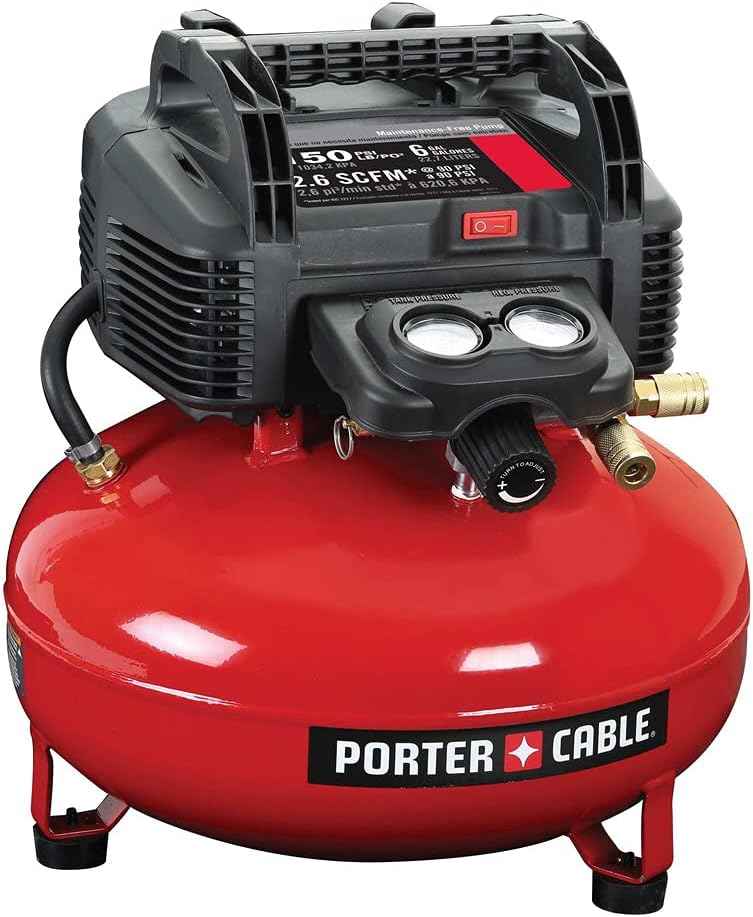
Pneumatic Tools (Nailers, Impact Wrenches): 6-30 Gallon Tanks
Pneumatic tools are unique—they consume high CFM (4-8 CFM) but only in short bursts (1-2 seconds). Between nail shots or bolt impacts, the compressor has time to catch up.
Framing nailers, roofing nailers:
6-20 gallon pancake or hot dog tanks work fine. You’re shooting one nail every 3-5 seconds, giving the compressor time to recover.
Impact wrenches (automotive):
20-30 gallon tanks recommended. Automotive work often involves sustained use (removing 20 lug nuts in a row), so you need more reserve capacity than framing.
Finish nailers, brad nailers:
6-10 gallon portable tanks are perfect. These tools use less CFM and you typically work slower (precision placement), so recovery time is built into your workflow.
Air Sanders and Grinders: 20-60 Gallon Tanks
Dual-action sanders and die grinders consume 8-12 CFM continuously. Unlike nailers, there’s no “burst and recover” pattern—you’re applying constant load.
Minimum: 20 gallons for light sanding work
Recommended: 60 gallons for professional auto body sanding
Why: Continuous CFM demand requires larger reservoir
Trying to run a DA sander on a 10-gallon pancake compressor means the motor runs constantly, the tank never fully recovers, and you’re fighting pressure drops that make the sander bog down.
Sandblasting: 60-120+ Gallon Tanks
Sandblasting is the most demanding pneumatic application—8 to 20+ CFM depending on nozzle size, and it runs continuously for 10+ minutes at a time.
Minimum: 60 gallons for small spot blasting (1/8″ nozzle, 8-10 CFM)
Recommended: 80-120 gallons for production blasting (3/16″ nozzle, 12-15 CFM)
Professional: 200+ gallons for heavy industrial blasting
Anything smaller and you’ll blast for 30 seconds, wait 2 minutes for recovery, blast for 30 seconds, wait 2 minutes… it’s maddening. Serious blasting requires serious tank capacity.
Tire Inflation and Shop Blow Gun: Any Size Works
These are low-CFM, intermittent tasks. Even a 6-gallon pancake compressor handles them fine because you’re using 2-3 CFM for 20-30 seconds at a time with long breaks in between.
Don’t size your compressor around these tasks—they’ll work with whatever you have. Size for your most demanding continuous-use application (painting, plasma cutting, sandblasting).
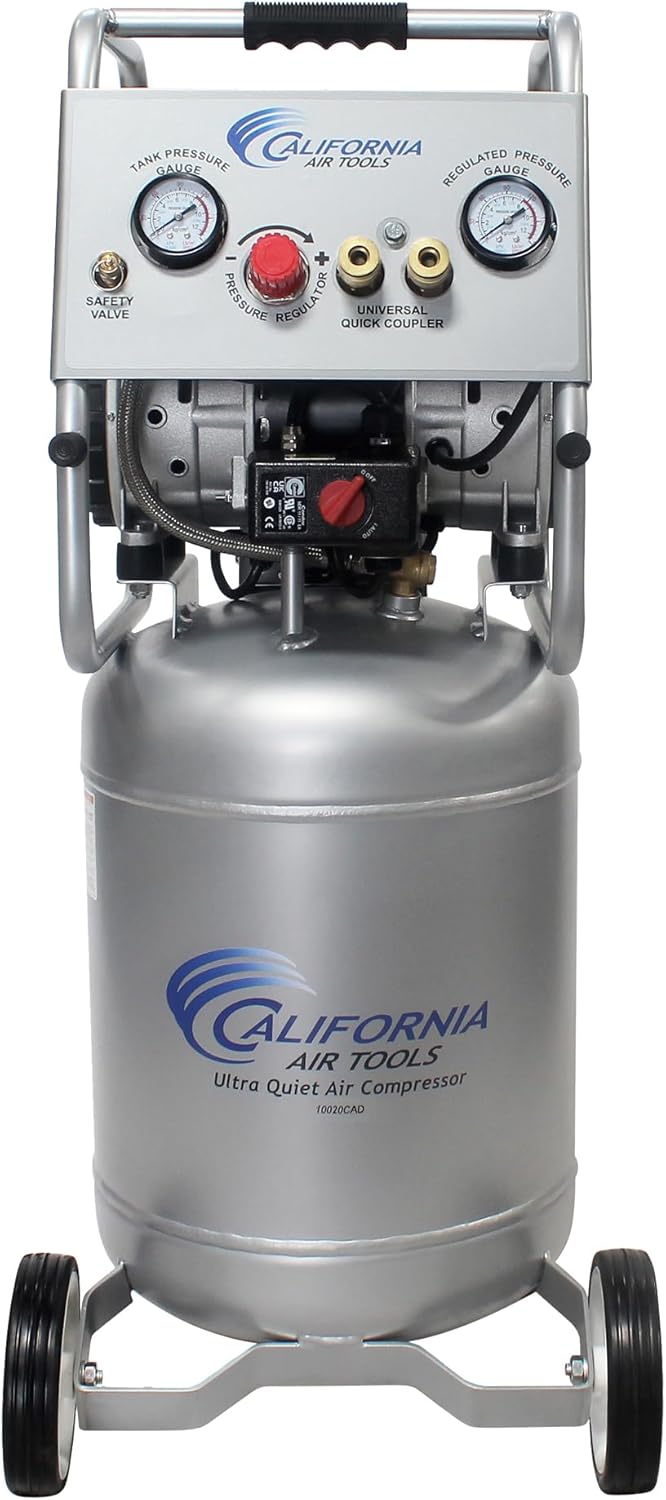
Portable vs. Stationary Tank Considerations
Tank size dramatically affects portability. There’s a natural divide between portable compressors (moved by one person) and stationary installations (stays in one place).
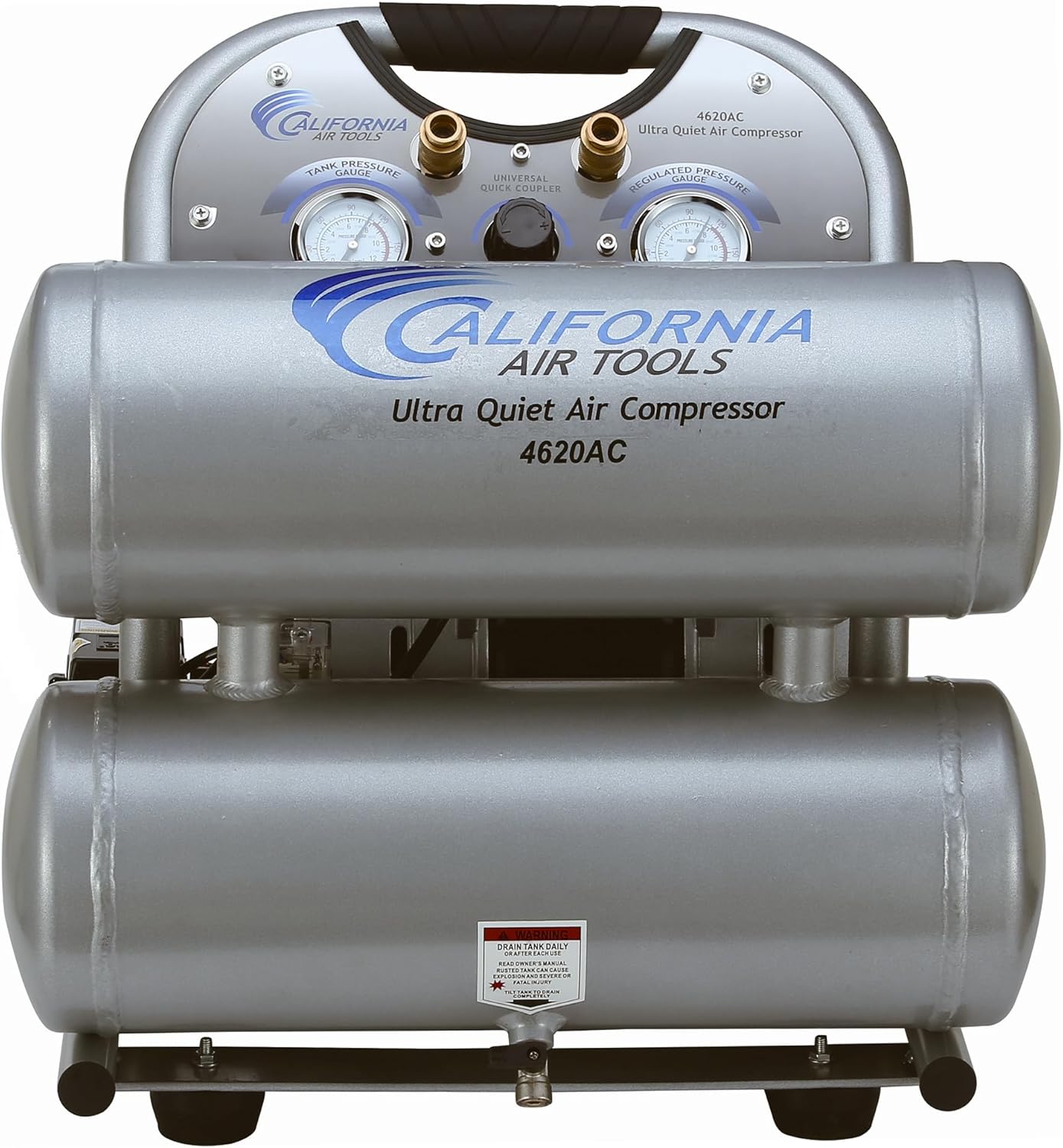
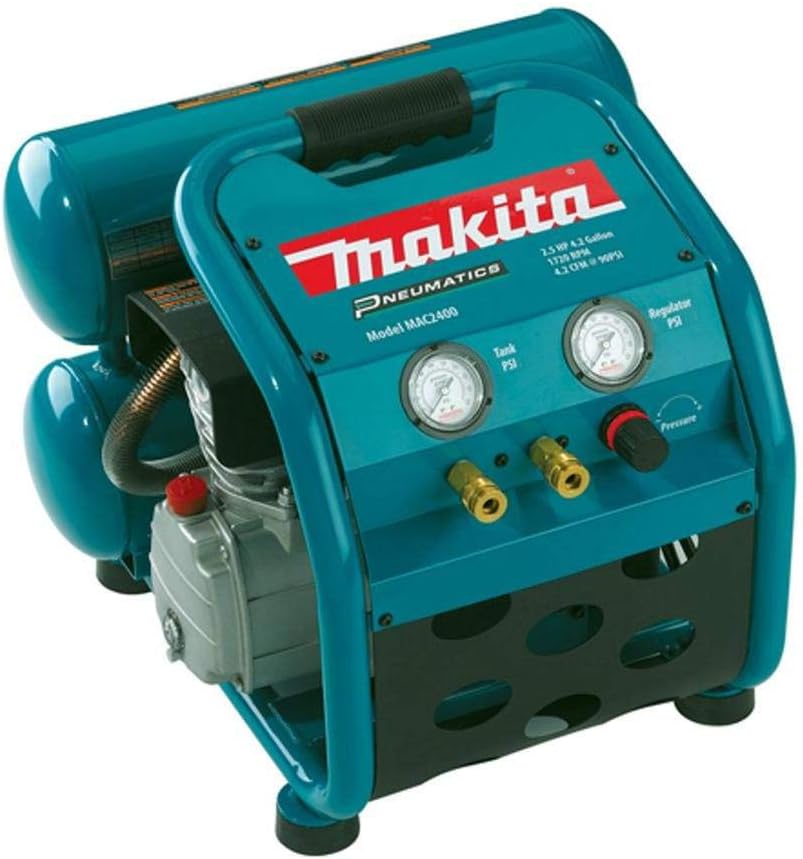
Portable Compressors: 1-30 Gallon Tanks
1-6 gallon “pancake” or “hot dog” tanks:
- Weight: 20-40 lbs (one-hand carry)
- Use case: Job site nailers, trim work, tire inflation
- Limitations: Can’t sustain continuous CFM draw
- Advantage: Extremely portable, fits in truck bed
20-30 gallon “wheelbarrow” or “twin stack” tanks:
- Weight: 100-150 lbs (two-person lift or dolly)
- Use case: Job site painting, mobile mechanic work, light fabrication
- Limitations: Heavy enough that you won’t move it often
- Advantage: More reserve capacity than pancake, still technically portable
Stationary Compressors: 60-120+ Gallon Tanks
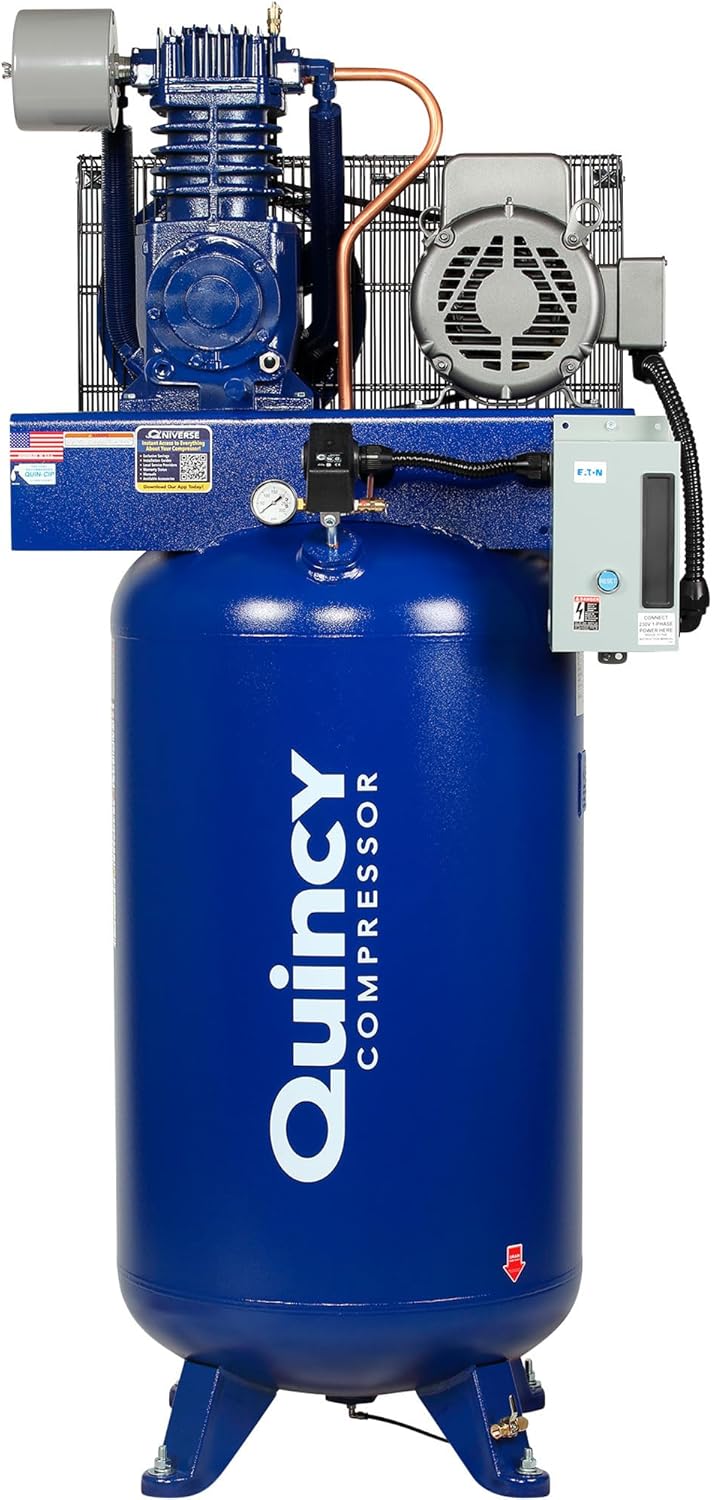
60-80 gallon vertical tanks:
- Weight: 300-400 lbs (permanent installation)
- Footprint: 2-3 sq ft (vertical orientation saves floor space)
- Use case: Small to medium shops, professional painting, plasma cutting
- Why stationary: Too heavy to move regularly; requires 240V hardwired power
120-200 gallon horizontal tanks:
- Weight: 600-1,000+ lbs
- Footprint: 6-10 sq ft
- Use case: Production shops, sandblasting, multiple simultaneous tools
- Installation: Often requires reinforced floor or concrete pad
The Portability Trade-Off
Every gallon of tank capacity adds roughly 8-10 lbs of weight (empty tank weight). A 30-gallon compressor might weigh 120-150 lbs, while a 60-gallon unit weighs 300-400 lbs.
Ask yourself:
- Will I ever need to move this compressor? (Job site work = portable)
- Can I dedicate a permanent spot in my shop? (Stationary = better performance)
- Do I have 240V available where I want to install it? (Larger tanks = 240V motors)
If you need portability, accept the performance limitations of smaller tanks and compensate with higher CFM output. If you can go stationary, buy the biggest tank your budget and space allow—you won’t regret the extra capacity.
Recovery Time and Duty Cycle
Recovery time is how long it takes the compressor to refill the tank from minimum pressure (cut-in) to maximum pressure (cut-out). This directly impacts your workflow—if recovery time exceeds your natural work pauses, you’re constantly waiting.
Recovery Time Formula
Recovery Time (minutes) = Tank Capacity (cubic feet) ÷ Compressor CFM
Tank capacity in cubic feet = Gallons × 0.1337
Example: 60-gallon tank with 10 CFM compressor
Tank capacity: 60 × 0.1337 = 8 cubic feet
Recovery time: 8 ÷ 10 = 0.8 minutes (48 seconds)
But this assumes drawing the tank completely empty, which doesn’t happen. Typically, compressors cycle when pressure drops 30-40 PSI from maximum.
Practical Recovery Examples
Scenario 1: Small tank, high CFM
20-gallon tank, 12 CFM compressor
Recovery time: ~20 seconds
Best for: Burst tools (nailers) with frequent pauses
Scenario 2: Medium tank, medium CFM
60-gallon tank, 10 CFM compressor
Recovery time: ~50 seconds
Best for: Intermittent use (plasma cutting with setup time between cuts)
Scenario 3: Large tank, moderate CFM
80-gallon tank, 12 CFM compressor
Recovery time: ~55 seconds
Best for: Spray painting (finish panel, move to next, compressor recovers)
Duty Cycle Considerations
Compressor motors have duty cycles just like welders. Consumer-grade compressors (50-60% duty cycle) should not run continuously—they need cool-down periods. Tank size affects this:
Small tank, low CFM compressor:
Motor runs almost constantly trying to keep up → overheats → thermal shutdown
Solution: Bigger tank reduces cycling frequency
Large tank, high CFM compressor:
Motor runs less frequently, stays cooler, lasts longer
Result: Can sustain higher workloads without overheating
This is why professional shops use oversized tanks—not just for runtime, but to protect motor longevity by reducing duty cycle stress.
Calculate your compressor’s operating costs and runtime with our Compressed Air Cost Calculator.

Common Tank Sizing Mistakes to Avoid
Mistake #1: Buying Tank Size Without Considering CFM
“I bought an 80-gallon compressor but it only delivers 8 CFM, and my plasma cutter needs 6 CFM. Why does the compressor run constantly?”
The problem: Tank size doesn’t matter if CFM output can’t keep up with demand. That 80-gallon tank will empty just as fast as a 20-gallon tank if the compressor only produces 8 CFM and you’re consuming 6 CFM continuously.
The fix: Always verify CFM rating FIRST, then choose tank size second. A 30-gallon compressor at 15 CFM will outperform an 80-gallon compressor at 8 CFM for continuous-use applications.
Mistake #2: Undersizing for Continuous Applications
“I’m trying to spray paint with a 10-gallon compressor. Why do I get orange peel and dry spray?”
The problem: Small tanks can’t maintain stable pressure during continuous high-CFM use. Pressure fluctuates as the tank cycles, causing inconsistent spray patterns.
The fix: Spray painting, sandblasting, and sustained sanding require 60+ gallon tanks MINIMUM. Don’t try to save money here—undersized tanks ruin expensive work.
Mistake #3: Oversizing for Burst Tools
“I bought an 80-gallon compressor for framing nailers. Was that overkill?”
The problem: Framing nailers use air in 1-2 second bursts with 3-5 second gaps. A 6-gallon pancake compressor recovers fast enough between nail shots. An 80-gallon tank is wasted capacity (and wasted money) for this application.
The fix: Match tank size to usage pattern. Burst tools = small tanks work fine. Continuous tools = bigger tanks required.
Mistake #4: Ignoring Voltage Requirements
“I bought a 60-gallon compressor but my garage only has 120V outlets. Now what?”
The problem: Compressors over 30 gallons typically require 240V power. You can’t run them on standard 120V household circuits—they’ll either not start or trip breakers constantly.
The fix: Before buying, check your electrical setup. If you only have 120V, limit yourself to 30-gallon tanks or get an electrician to install a 240V circuit.
Mistake #5: Not Accounting for Multiple Tools
“My plasma cutter needs 6 CFM and my grinder needs 8 CFM. I bought a 12 CFM compressor with a 30-gallon tank. Why can’t I run both at once?”
The problem: 6 CFM + 8 CFM = 14 CFM total demand. Your 12 CFM compressor can’t keep up, and the 30-gallon tank will empty in under 2 minutes.
The fix: If you’ll ever run multiple tools simultaneously, add their CFM requirements together and size accordingly. For two tools (14 CFM combined), you’d need at least 16 CFM output and a 60-80 gallon tank to avoid constant cycling.
Mistake #6: Forgetting About Altitude
“My compressor is rated for 10 CFM at sea level, but I’m at 7,000 feet elevation. Why is performance bad?”
The problem: Air is thinner at altitude. CFM output decreases roughly 3% per 1,000 feet of elevation. At 7,000 feet, your “10 CFM” compressor is actually delivering ~7.9 CFM.
The fix: If you’re above 3,000 feet elevation, size up by 10-20% on both CFM and tank capacity to compensate for thinner air.
Frequently Asked Questions
What size air compressor tank do I need for a plasma cutter?
For plasma cutting, you need a minimum 30-gallon tank for 30A cutters (4-5 CFM) or a 60-gallon tank for 50A+ cutters (6-8 CFM). Plasma cutting demands stable, consistent pressure—smaller tanks cause the compressor to cycle frequently, creating pressure drops that degrade cut quality with wandering arc and excessive dross. The larger tank provides a buffer that maintains steady pressure throughout the cut.
Is a 20-gallon air compressor big enough for spray painting?
No, a 20-gallon tank is too small for spray painting. HVLP spray guns consume 8-15 CFM continuously and require absolutely stable pressure to prevent orange peel, dry spray, and spitting. You need a minimum 60-gallon tank for automotive HVLP work, with 80-120 gallons recommended for professional results. Small tanks cycle constantly during spraying, causing pressure fluctuations that ruin expensive paint jobs.
How do I calculate what size air tank I need?
Use this formula: Minimum Tank Size (gallons) = (Tool CFM × Runtime Minutes × 7.5) ÷ Pressure Drop. For example, if your tool uses 8 CFM and you want 5 minutes of runtime with a 30 PSI pressure drop: (8 × 5 × 7.5) ÷ 30 = 10 gallons minimum. However, add 30-50% safety margin for real-world use. Use our Tank Size Calculator for instant recommendations.
Does tank size affect CFM output?
No, tank size does not affect CFM output. CFM is determined by the compressor motor and pump design, not the tank. A 60-gallon tank doesn’t deliver more CFM than a 20-gallon tank—it just stores more compressed air, allowing you to work longer before the compressor needs to refill. Think of it like a car’s gas tank: bigger tanks let you drive farther, but they don’t make the car go faster.
What’s better for a small shop: vertical or horizontal tank?
Vertical tanks are better for small shops because they minimize floor space—a 60-gallon vertical tank occupies about 2-3 square feet of floor space versus 6-8 square feet for a horizontal tank. Vertical tanks are typically 5-6 feet tall, so you need adequate ceiling height (8+ feet), but they free up valuable shop floor for other equipment. Horizontal tanks are better for low-ceiling garages or when you need the compressor under a workbench.
Can I run a plasma cutter and grinder off the same compressor?
Yes, but your compressor must have enough CFM for BOTH tools combined, and you need a larger tank. If your plasma cutter needs 6 CFM and your grinder needs 8 CFM, that’s 14 CFM total demand. You’d need at least a 16 CFM compressor with an 80-gallon tank to run both simultaneously without constant cycling. If your compressor doesn’t have sufficient CFM, the tank will empty quickly and you’ll spend more time waiting than working.
How long does it take to fill an 80-gallon air tank?
Fill time depends on the compressor’s CFM rating. Using the formula: Fill Time = (Tank Gallons × 0.1337) ÷ Compressor CFM. For an 80-gallon tank with a 10 CFM compressor: (80 × 0.1337) ÷ 10 = 1.07 minutes or about 64 seconds from empty. However, compressors rarely fill from completely empty—typical cycles refill from 120 PSI to 150 PSI, which takes 30-50% less time.
Do I need a bigger tank if I’m at high altitude?
Yes, altitude affects both CFM output and effective tank capacity. Air is thinner at elevation, reducing compressor efficiency by approximately 3% per 1,000 feet of altitude. At 5,000 feet, a compressor rated for 10 CFM at sea level actually delivers about 8.5 CFM. To compensate, size up 10-20% on both CFM rating and tank capacity if you’re above 3,000 feet elevation.
What size compressor do I need for sandblasting?
Sandblasting is the most demanding pneumatic application, requiring an 80-120 gallon tank minimum with 15+ CFM for production work. A 1/8″ sandblasting nozzle needs 8-10 CFM continuously, while a 3/16″ nozzle needs 12-15 CFM. Anything smaller and you’ll blast for 30 seconds, then wait 2-3 minutes for recovery. Professional sandblasting operations typically use 200+ gallon tanks with 20+ CFM output.
Can I add an auxiliary tank to increase capacity?
Yes, you can add an auxiliary air tank to increase total storage capacity. Connect the auxiliary tank to your existing compressor’s output line with appropriate fittings and pressure-rated hose. The combined capacity of both tanks gives you longer runtime between compressor cycles. This is a cost-effective way to boost capacity without replacing your entire compressor, especially useful for spray painting or sandblasting where you need more reserve air but your compressor CFM is adequate.
Conclusion: Match Tank Size to Your Actual Usage
Choosing air compressor tank size isn’t about buying the biggest tank you can afford—it’s about matching tank capacity to your specific tools and usage patterns. A 20-gallon tank might be perfect for framing nailers but completely inadequate for spray painting. A 60-gallon tank solves plasma cutting pressure stability but is overkill for tire inflation.
The right approach:
- Identify your highest CFM tool and verify your compressor can deliver that CFM
- Determine if usage is burst or continuous (burst = smaller tank works; continuous = bigger tank required)
- Calculate minimum tank size based on desired runtime between cycles
- Add 30-50% safety margin to avoid operating at the edge of capacity
- Consider future tools you might add to avoid undersizing now
For most fabrication shops doing welding, plasma cutting, and occasional painting, a 60-80 gallon tank with 12-15 CFM output hits the sweet spot—enough capacity for continuous work, fast enough recovery between jobs, and room to grow without constant cycling.
Use our free calculators to dial in your exact requirements:
- Tank Size Calculator – Get instant gallon recommendations
- CFM Calculator – Calculate your tool’s air requirements
- Runtime Calculator – See how long your tank will last
- Cost Calculator – Calculate operating and electricity costs
Gallons are not SCFM. Tool demand: Per-Tool CFM Requirement Calculator, CFM Requirement Chart, and the CFM Requirement Guide.
Have questions about sizing your air compressor? Drop a comment below or reach out—we’re here to help!
Any trade
Contractor Job Estimator
Price remodels and GC work, then send a quote with no internal numbers.
Excel or Google Sheets. Best on a computer.
$29.00
BuyCheckout opens in a new tab.