Short Circuit Current Troubleshooting
When the available fault current, transformer %Z, source contribution, or equipment AIC rating don't add up on a coordination study
This is field/plan-review diagnosis of available fault current inputs — not a formula tutorial. Compute available short-circuit current with the Short Circuit Current Calculator. Learn the point-to-point method, %Z, and AIC basics in the Short Circuit Current Guide. When the underlying Ohm's Law / impedance assumptions are wrong, see Ohm's Law Troubleshooting.

Short Circuit Current Problems Quick Answer
Use this when the point-to-point math ran clean but the answer fails an AIC check or a plan reviewer's comment. Most failures are bad source data (%Z, kVA, utility contribution) or a rating concept misapplied — not arithmetic.
| Symptom | What it usually means | First fix | Next tool |
|---|---|---|---|
| Fault current > equipment AIC | Device underrated for the available fault at that point | Raise AIC, add current-limiting, or use a listed series rating | Fault Current Calculator |
| Answer swings wildly with %Z | Transformer %Z guessed or taken from wrong nameplate | Use the actual unit's %Z; check tolerance band | Fault Current Guide |
| Infinite-bus number way too high | Ignored utility source impedance | Get utility available fault kA at the service | Fault Current Calculator |
| Motors/generator ignored | On-site generation and motor contribution left out | Add motor and generator fault contribution | Fault Current Guide |
| "Series rated" applied loosely | Series rating used without a tested/listed combo | Verify the listed series combination or go fully rated | Fault Current Guide |
1. Calculated Fault Current Exceeds Equipment AIC / SCCR
What it looks like: The available fault current at a panel or device is higher than the breaker's interrupting rating (AIC) or the assembly's short-circuit current rating (SCCR). A plan reviewer flags it, or a device is installed where it could fail to safely interrupt a fault.
Likely causes: Equipment specified from cost or habit (10 kAIC breakers) while the real available fault current close to a large service transformer is 22 kA+. SCCR of a control panel dragged down by its weakest component. Assuming distance/impedance knocked the number below the device rating when it didn't.
Fixes: Recompute the available fault at that exact point with the Short Circuit Current Calculator, then either specify higher-AIC devices, add a current-limiting device upstream, or use a listed series-rated combination (section 4). This is a rating-compliance fix, not a technique choice.
2. Transformer %Z Data Errors
What it looks like: The fault current answer changes dramatically with small input tweaks, or two engineers get very different numbers from the "same" transformer. The secondary available fault is inversely proportional to %Z, so a wrong impedance throws everything off.
Likely causes: Using a generic %Z instead of the actual unit's nameplate value; ignoring the ±7.5% (or ±10%) manufacturing tolerance on impedance; mixing up %Z at a different kVA base; or using the self-cooled (OA) rating when the unit runs at a forced-cooled (FA) rating. Lower %Z → higher fault current, so a guess on the low side can hide a real AIC problem, and a guess on the high side can mask it.
Fixes: Pull the actual transformer nameplate %Z, apply the worst-case tolerance (use the minimum %Z for the maximum available fault current), confirm the kVA base, and re-run the calculator. The Short Circuit Current Guide covers the %Z-to-fault relationship in detail.
Design to the lowest %Z in tolerance. It yields the highest available fault current — the value your equipment must survive.
Recalculate3. Utility vs On-Site Generation Contribution Mistakes
What it looks like: An "infinite bus" assumption produces an unrealistically high fault current (over-conservative), or the study omits motors and generators and produces a fault current that's too low (unsafe). Either way the coordination study is wrong.
Likely causes and fixes:
- Utility source impedance ignored (infinite bus): Treating the utility as a source of unlimited fault current inflates the answer. Fix: get the utility's available fault current (kA or MVA) at the service point and include its impedance.
- Motor contribution omitted: Large running motors dump current into a nearby fault for the first few cycles. Fix: add motor contribution (a common approximation is 4× FLA for the group) for the momentary/first-cycle rating.
- On-site generator ignored or double-counted: A standby/parallel generator adds fault current when online; forgetting it understates the fault, while adding a generator that can't be paralleled overstates it. Fix: include generation only in the operating modes where it actually contributes.
Get the source data right first — the Short Circuit Current Guide explains where each contribution enters the point-to-point method, then confirm totals on the calculator.
4. Series-Rated vs Fully-Rated Confusion
What it looks like: A downstream breaker with a low AIC is installed where the available fault exceeds its standalone rating, justified as "series rated" with the upstream device — but without a tested, listed combination. Or a fully-rated design is assumed where a series rating was actually required.
The distinction:
- Fully rated: Every overcurrent device has an interrupting rating at least equal to the available fault current at its point. Simple, always compliant, sometimes more expensive.
- Series rated: A specific upstream + downstream device combination tested and listed by the manufacturer lets the downstream device be applied above its standalone AIC. Only valid for the exact listed pairing, and subject to the motor-contribution limitation (series ratings can be voided where motor contribution between the devices exceeds 1% of the downstream AIC).
Fixes: If you rely on a series rating, document the manufacturer's listed combination and confirm the motor-contribution rule. If you can't cite a listed pairing, go fully rated. Verify the available fault at each device with the calculator; the guide details both approaches.
No "Decision" Article 3 for This Cluster — Here's Why
Article 3 SKIPPED because there is no genuine choose-A-vs-B decision. Verifying that available fault current stays within equipment AIC/SCCR is compliance math, not a technique or product decision. The only real "choice" — fully rated vs a listed series-rated combination — is a code/listing requirement handled in the guide, not an open trade-off worth its own decision page. Writing a decision article here would either duplicate the guide or invent a false either/or.
Use the calculator for the numbers and the guide for method and rating rules.
Short Circuit Current Calculator → Short Circuit Current Guide → Ohm's Law Troubleshooting →
Recommended Tools for Fault Current & AIC Checks
Five CSV catalog picks with verified images — measure service voltage and load current, verify device ratings in the field, and confirm de-energization

Fluke 117 Electricians True RMS Multimeter
- True-RMS service voltage for the study
- Verify line-to-line and line-to-ground
- CAT III for service/panel work
- Electrical catalog

Klein Tools CL800 Digital Clamp Meter
- 1000V TRMS feeder/service current
- Verify motor FLA for fault contribution
- Inrush capture for first-cycle checks
- Electrical catalog

Ideal Industries 61-757 Clamp Meter
- 600A AC/DC TRMS for service checks
- Confirm operating load vs nameplate
- TightSight for tight panel work
- Electrical catalog
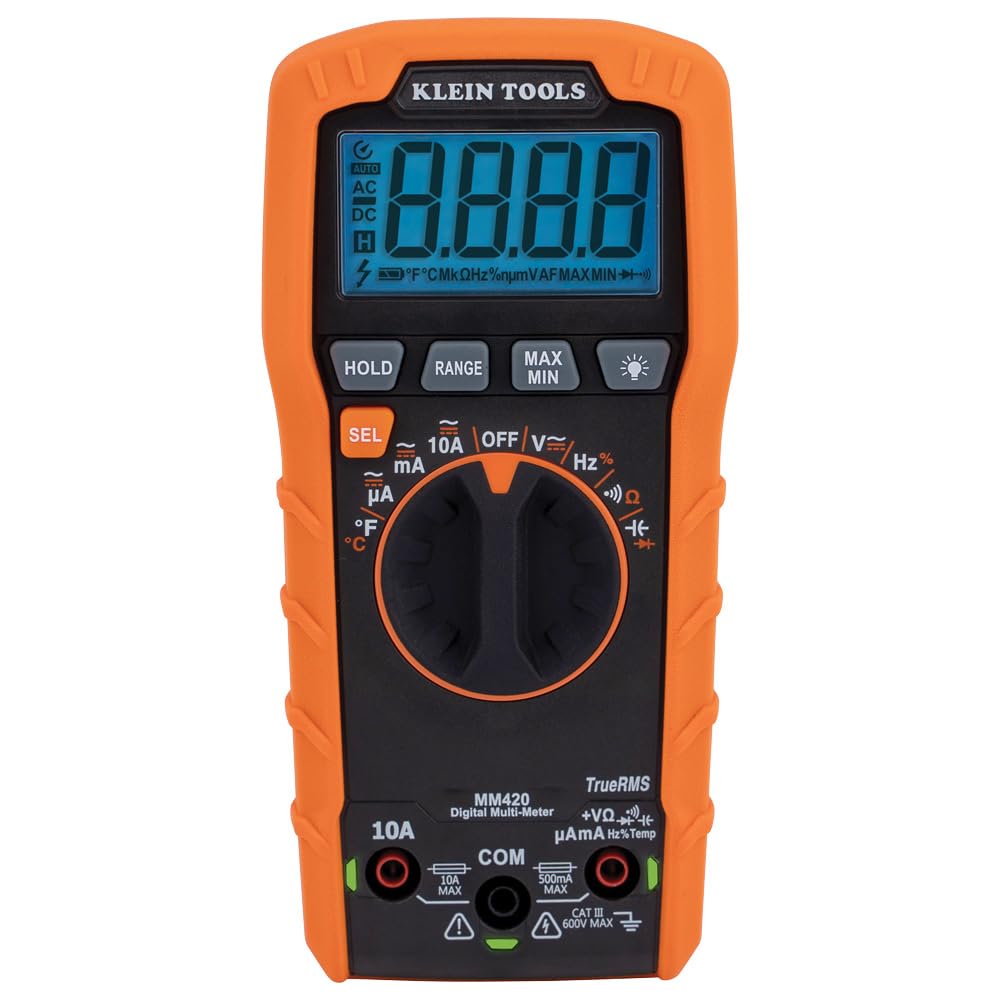
Klein Tools MM420 Auto-Ranging Multimeter
- TRMS V and continuity in the field
- Spot-check nameplate vs measured
- Backup meter for service work
- Electrical catalog

Klein Tools NCVT-3P Non-Contact Voltage Tester
- Confirm de-energized before opening gear
- Dual-range presence check
- Essential PPE step at the service
- Electrical catalog
As an Amazon Associate, TestTalkHQ earns from qualifying purchases. All five cards are sourced only from the affiliate CSV with verified product images. Field meters confirm the inputs (V, FLA) — the interrupting rating (AIC/SCCR) itself is read from equipment labels and manufacturer listings, not measured.
Frequently Asked Questions
My fault current is higher than the breaker AIC — what now?
Specify a higher-AIC device, add an upstream current-limiting device, or use a manufacturer-listed series-rated combination. It's a rating-compliance fix; recompute the available fault at that point first.
Which transformer %Z should I use — nominal or tolerance?
For maximum available fault current (the worst case equipment must survive), use the minimum %Z within the unit's tolerance band, from the actual nameplate at the correct kVA base.
Do I really have to include motor contribution?
Yes for the momentary/first-cycle duty near large motors — they feed the fault for the first few cycles. Omitting it understates the fault current the equipment must interrupt or brace against.
Can I just call a design "series rated"?
No. A series rating only exists as a specific upstream+downstream combination tested and listed by the manufacturer, and it's subject to the motor-contribution limitation. If you can't cite the listed pairing, go fully rated.
Why is there no decision (Article 3) page here?
Because AIC/SCCR verification is compliance math, not a technique or product choice. The only real fork — fully rated vs listed series rating — is a code/listing rule covered in the guide, not an open trade-off worth a standalone decision article.