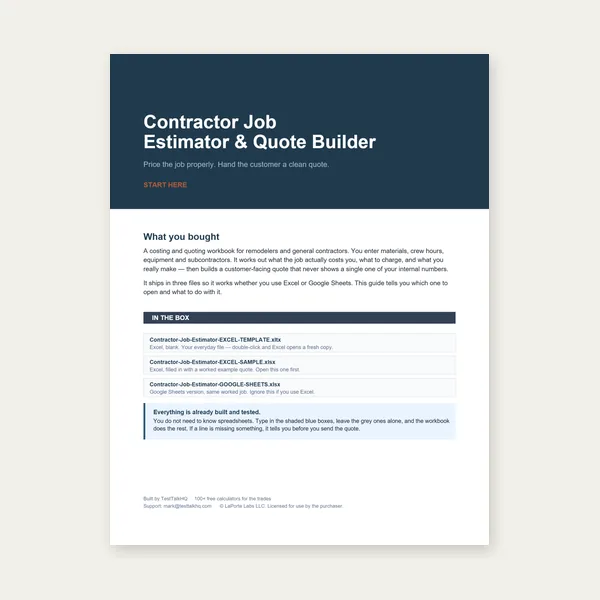
Contractor Job Estimator
$29.00
BuyWhy ethylene glycol plus distilled water beats either alone, how to read a refractometer, climate-driven ratios, and IAT vs OAT/HOAT service intervals
Run the volumes in the coolant mix ratio calculator. Field failures: troubleshooting. Pre-mixed vs concentrate: comparison. Related: MPG, trip fuel cost, towing capacity. Hub: automotive tools.
Know capacity and target mix before you open the cap. Quarts/liters of concentrate and distilled water, freeze/boil check, top-off math.
Open Coolant Mix Calculator →Pure water transfers heat well but freezes near 32°F and boils near 212°F at atmospheric pressure. Pure ethylene glycol lowers freeze point dramatically but transfers heat poorly and freezes around 8°F by itself. A mix gets both: freeze protection well below 32°F and a higher boil point under the 15 psi radiator cap that most passenger cars run.
The protection curve is not linear and it is not “more antifreeze = always better.” Past roughly 70% concentrate, freeze protection stops improving and can reverse near the eutectic. That is why the calculator warns above 70% and why OEM manuals rarely recommend straight antifreeze.
A refractometer is the shop-favorite tool: one drop on the prism, close the lid, read the EG scale through the eyepiece. Fast, repeatable, and hard to misread compared to floating balls.
A hydrometer (floating balls or a float stem) still works on EG mix but is temperature-sensitive and easier to contaminate. Either tool must match the chemistry you actually have (EG vs PG scales differ).
After mixing, re-check the closed system. Math gets you close; the refractometer is the sign-off.
Pick a target freeze point with margin below your coldest expected overnight low, not just average winter highs. The calculator’s freeze mode inverts the EG/water curve to suggest concentrate %.
| Typical climate band | Starting ratio | Approx. freeze (°F, 15 psi) |
|---|---|---|
| Mild / occasional frost | 40/60 to 50/50 | 0°F to −34°F |
| Cold winters | 50/50 to 60/40 | −34°F to −62°F |
| Severe cold (with margin) | 60/40 to 70/30 | −62°F to −84°F |
IAT (inorganic additive technology, often green) — traditional silicate/phosphate package. Typical change interval roughly 2 years / 30,000 mi. Good for older iron blocks; silicates protect fast but deplete.
OAT / HOAT (organic / hybrid organic acid) — long-life packages (Dex-Cool-style orange, some yellow/pink HOAT). Often 5 years / 100,000–150,000 mi on the label. Do not mix with IAT without a full flush — gel and sludge are common.
Ratio math is the same; chemistry compatibility is not. Match the bottle to what is already in the expansion tank unless you are flushing.
Fresh fill (empty system after flush/repair): concentrate = capacity × r, water = capacity × (1 − r).
Top-off / adjust from a known current %: partial drain-and-replace math in the calculator — raising concentration drains low-% fluid and replaces with concentrate; lowering concentration drains and replaces with distilled water.
Default 12 qt / 50/50 worked example: 6 qt concentrate + 6 qt water, −34°F freeze, 265°F boil at 15 psi.
Coolant Mix Calculator →It is the common pre-mixed default for moderate climates. Colder regions may need 60/40; never exceed ~70% concentrate.
Yes for EG if you read at the correct temperature and rinse between samples. Refractometers are faster for repeated checks.
Refractometer and coolant affiliate picks are pending in the live CSV. Calculator and guide stand alone until sourced.
$29.00
BuyCheckout opens here — you stay on this page.