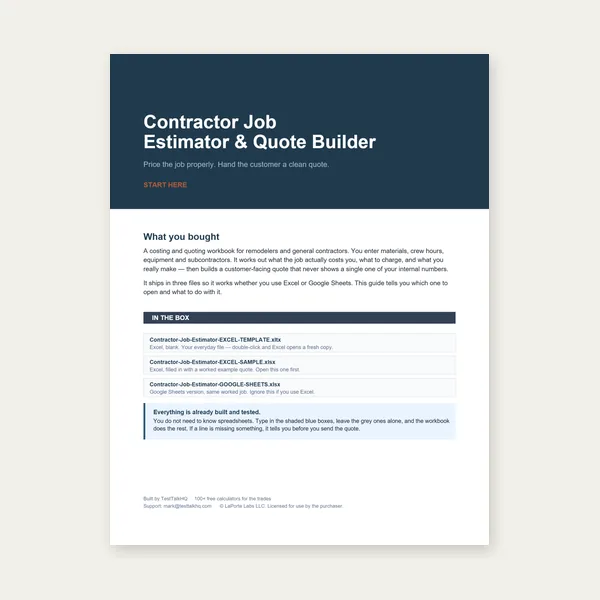
Contractor Job Estimator
$29.00
BuyHow IPC Equation 11-1 turns plan area and inches-per-hour into gallons per minute, how to look up a local design rainfall rate, and why a trough that looks fine most of the year still sheets over the fascia in a cloudburst
The gutter & downspout sizing calculator returns required flow, 5" vs 6" K-style, and downspout count. This page is why roof plan area and rainfall intensity both sit in that equation, and how to find the intensity your plumbing code actually wants. It is not a shingle takeoff — squares and bundles are the roofing square calculator.
Overflow vs clog vs slope: troubleshooting. When the extra inch of K-style is worth it: 5" vs 6" comparison. Attic airflow under the same roof: attic ventilation calculator. Roofing index: hub. Ice barrier under the first courses: ice & water shield coverage calculator.
Have plan area and a rainfall guess?IPC Eq. 11-1 flow, SMACNA pitch factor, 5" vs 6" K-style and downspout count.
Open Calculator →A gutter is a horizontal channel that has to carry the water that hits a roof in a design storm, then hand that water to a vertical leader. Two numbers set the load:
Either number alone is a guess. A huge roof in a dry climate can live on 5" K-style. A modest roof in a 6 in/hr rainfall map cannot. The code multiplies them.
$29.00
BuyCheckout opens here — you stay on this page.
The calculator returns gallons per minute and a 5" or 6" call. A guard, a downspout extender, and a scoop are how that capacity survives leaves and keeps discharge off the foundation.

Fits 4, 5, and 6 in K-style gutters. Guards do not add capacity — size the trough first, then keep leaves from eating that capacity.
View on Amazon →
Fits 2x3 and 3x4 downspouts. The calculator sizes the spout; the extender is how you keep that discharge off the foundation.
View on Amazon →
Flexible scoop that fits K-style troughs. Overflow that looks like a sizing problem is often a clog — clean it before you upsize.
View on Amazon →
Plan area, SMACNA pitch factor, and rainfall intensity. Flow in gpm, 5" vs 6" K-style, downspout count.
Open Gutter Calculator →
Length × width footprint on the square calculator. Use that plan number here — do not paste sloped squares into drainage math.
Open Roofing Square Calculator →
Shingle takeoff, attic NFA, and gutter flow. Three different jobs on one index.
Open Roofing Hub →As an Amazon Associate, TestTalkHQ earns from qualifying purchases.
2021 International Plumbing Code Section 1106.2.1 (text as published on UpCodes and in the ICC IPC 2021 Chapter 11): convert the rainfall rate falling on a roof surface to a gallon-per-minute flow with Equation 11-1.
A is roof area in square feet. i (R in the code) is rainfall intensity in inches per hour. The constant is not a fudge factor: one inch of rain on one square foot is 0.623 gallons; divide by 60 minutes and you get 0.0104 gpm per square foot per inch per hour. Same arithmetic shows up in ASCE 7 commentary on roof drainage.
Once you have Q, IPC 1106.6 says the flow in a horizontal gutter shall not exceed Table 1106.6. At the usual 1/8 in/ft slope, a 5" semicircle is listed at 74 gpm and a 6" semicircle at 110 gpm. Footnote a: single dimensions are diameters of a semicircle. Residential K-style is the profile you hang; this cluster does not claim a 5" K-style beats 74 gpm.
Vertical leaders are Table 1106.3: a 2" / 2×2 leader is 30 gpm; a 3" / 2×4 / 2½×3 leader is 92 gpm. Common 2×3 and 3×4 residential downspouts are not named rows — the calculator treats 2×3 as 30 gpm (conservative) and 3×4 as 92 gpm.
Rain falls (mostly) vertically. The catchment for drainage is the plan/footprint of the slope, not the sloped deck you buy shingles for. The square calculator multiplies footprint by √(1+(X/12)²) because you are covering the actual surface. Paste that sloped number into gutter math and you have double-counted slope.
What pitch does change for gutters is wind-driven rain. SMACNA Architectural Sheet Metal Manual Table 1-1 (reproduced in manufacturer gutter-sizing notes such as Berger’s Proper Gutter and Downspout Sizing) applies a design-area factor to plan area:
| Roof pitch | SMACNA Table 1-1 factor |
|---|---|
| Level through 3/12 | 1.00 |
| 4/12 through 5/12 | 1.05 |
| 6/12 through 8/12 | 1.10 |
| 9/12 through 11/12 | 1.20 |
| 12/12 and steeper | 1.30 |
A 6/12 roof’s geometric shingle factor is about 1.118. The SMACNA drainage factor is 1.10. Close on that pitch, not interchangeable on a 12/12. IPC 1106.4 also wants half of any vertical wall that sheds onto the roof added to the projected area — a tall gable wall dumping onto a low slope is extra catchment the calculator does not invent for you.
IPC 1106.1 is explicit: size vertical conductors, leaders, and storm drains on the 100-year hourly rainfall rate in Figures 1106.1(1) through 1106.1(5), or on other rainfall rates from approved local weather data. Those figures are NOAA / National Weather Service 100-year, 1-hour maps for the western, central, and eastern United States, plus Alaska and Hawaii.
Practical lookup:
Jurisdictions amend. Some stormwater manuals want a 10-year or 25-year event for gutters and a larger event for overflow scuppers. If the inspector cites a local table, use that intensity. Do not size a critical job off a default you have not checked.
Most of the year the trough is empty or carrying a trickle. A 5" K-style on a 2,000 sq ft eave at 2 in/hr is bored. The same eave at 5 in/hr is a different machine: Q scales linearly with intensity. The overflow happens in the hour the map was drawn for, not in the drizzle you watched from the kitchen.
That is why “it only overflows in storms” is often a sizing diagnosis, not a complaint about the weather. A correctly sized trough still overflows if it is full of leaves, pitched backward, or dumping two downspouts’ worth of water into one 40-foot run. Sort those on the troubleshooting page. If the trough is clean, pitched, and still sheets over the front edge in a design-level rain, the catchment or the intensity was never in the hang.
Only if you convert back to plan area. A square is 100 sq ft of sloped surface. Drainage wants footprint, then the SMACNA factor. Use the square calculator’s plan/footprint output, not the after-pitch total.
No. IPC 1106.1 wants the 100-year hourly rate for your location. 4 in/hr is a convenient default on this site so the form runs; check NOAA Atlas 14 or the IPC map for anything you will hang.
Not for that reason. Catchment is plan area. Steeper roofs get a modest SMACNA wind-driven-rain factor (up to 1.30 at 12/12), which is not the same as covering more shingles.